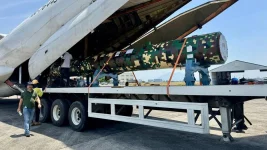
India’s roadmap for hypersonic weaponry is gaining significant momentum, with the much-anticipated BrahMos-II missile now scheduled for its maiden flight test in the 2027–28 timeframe.
According to a recent report by WION, this development represents a watershed moment in the nation's missile history, placing India within an elite tier of countries striving for reliable and repeatable hypersonic strike capabilities.
Preliminary indicators suggest that BrahMos-II will not merely be an upgrade to the existing BrahMos supersonic cruise missile, but a transformative platform capable of redefining deterrence strategies across the Indo-Pacific region.
Testing the Limits of Speed and Propulsion
The inaugural flight test is set to rigorously validate three pivotal technologies. The primary goal is to demonstrate sustained cruise performance at Mach 8—eight times the speed of sound. This benchmark would firmly establish the missile in the upper echelon of global hypersonic systems.To achieve such blistering velocities, the missile will rely on a scramjet (supersonic combustion ramjet) propulsion system. Unlike traditional engines, a scramjet efficiently compresses incoming air at supersonic speeds without rotating parts, maintaining stable combustion.
Open-source defence data indicates that this technology builds upon the success of the Defence Research and Development Organisation’s (DRDO) Hypersonic Technology Demonstrator Vehicle (HSTDV), which successfully demonstrated autonomous scramjet flight in September 2020.
Overcoming the Plasma Barrier
A second critical objective is ensuring guidance accuracy in the extreme hypersonic domain. Flight at Mach 8 generates a "plasma sheath"—a layer of ionized gas around the missile that can block radio, radar, and GPS signals, effectively blinding standard navigation systems.Engineers are tasked with developing advanced algorithms and hardened sensors capable of penetrating this communication blackout.
Success in this area would mean BrahMos-II could drastically reduce the reaction time available to adversaries, providing India with a potent countermeasure against the increasingly sophisticated missile defence networks emerging in the region.
Mastering Thermal Resilience
The scheduled tests will also evaluate the missile's structural integrity under extreme heat. Hypersonic flight exposes the airframe to temperatures exceeding 2,000°C. To survive these conditions, the missile must utilize ultra-high-temperature ceramics and advanced composite structures.Industry experts note that the BrahMos-II programme is likely benefiting from the exchange of technical know-how with Russia.
The missile is widely believed to share design lineage with Russia’s 3M22 Zircon (Tsirkon) hypersonic missile, which has already demonstrated Mach 9 capabilities in operational tests.
This collaboration, combined with indigenous materials research, aims to create a highly survivable airframe.
Strategic Implications for the Indo-Pacific
Defence analysts highlight that the 2027–28 testing window supports India’s broader ambition to field a layered hypersonic arsenal by the early 2030s.With major powers like the U.S., China, and Russia aggressively deploying similar technologies, India’s ability to master Mach 8 precision strikes carries immense strategic weight.
In an era where anti-access/area-denial (A2/AD) strategies are dominating the Indo-Pacific theatre, systems like BrahMos-II offer a unique advantage.
They provide the capability to penetrate heavily defended airspace and strike time-sensitive targets with little warning, ensuring credible deterrence even in contested electronic warfare environments.
A New Era of Indigenous Defence
For India, the successful testing of BrahMos-II will symbolize more than just technical achievement; it will mark the maturation of a homegrown hypersonic ecosystem.This programme integrates complex propulsion, material science, and high-speed aerodynamics into a single, operationally viable package.
As development teams refine the scramjet engine and integrate next-generation seekers, the coming years will be decisive in preparing this game-changing platform for its first launch.