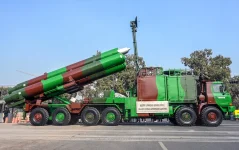
Indian private sector aerospace firm Paninian India Private Limited has unveiled its newly developed Yantur Ramjet Engine.
This advanced air-breathing propulsion system is engineered to sustain flight at supersonic and hypersonic speeds, representing a massive technological step forward for indigenous private-sector military engineering.
The company aims to deploy this engine across a range of next-generation high-speed weapons systems, long-range cruise missiles, and high-velocity unmanned aerial systems (UAVs) under its broader "Svayatt" autonomous military platform initiative.
The expansion comes as Paninian scales up its operations.
Founded in 2020 by aerospace engineers with deep roots in India's premier defence research bodies like the Defence Research and Development Organisation (DRDO) and Hindustan Aeronautics Limited (HAL), the deep-tech startup operates out of a highly advanced 50,000-square-foot facility equipped with simulation labs and wind tunnels.
The development of the Yantur Ramjet highlights the rising capabilities of commercial firms to independently tackle complex aero-engine engineering.
Overcoming Technical Barriers at Mach Speeds
Ramjet propulsion relies on the high forward speed of the vehicle to compress incoming air, meaning the architecture must handle extreme aerodynamics without moving parts.The Yantur design addresses this by utilising a sophisticated shock compression sequence composed of oblique and normal shocks.
This layout systematically slows down supersonic incoming airflow to subsonic speeds before it enters the combustor.
This controlled deceleration ensures stable, highly efficient, and predictable fuel ignition at extreme velocities, preventing the engine flame from blowing out.
Operating at supersonic and hypersonic speeds subjects materials to intense thermal loads.
To manage this, Paninian has engineered the engine using advanced high-temperature materials and protective coatings capable of withstanding thermal extremes reaching approximately 2400K.
Furthermore, the company has integrated a dual-purpose "thermal oxidant fuel system."
In this design, the onboard fuel passes around the combustion chamber to act as a vital cooling liquid before it is injected to burn for propulsion.
This active thermal management safeguards the engine’s structural integrity and extends its operational life during prolonged high-speed operations.
Algorithmic Flight Controls and Acoustic Management
Beyond heat management, the team has implemented specialized physical design counter-measures within the combustion chamber to neutralise thermal-acoustic instabilities—a violent vibration issue that frequently damages high-speed experimental powerplants.The physical stabilization is paired with an adaptive fuel control system.
Driven by advanced optimal control algorithms, this digital system dynamically recalculates and adjusts fuel scheduling in real-time as the vehicle accelerates through different Mach numbers.
The constant software adjustment ensures maximum fuel economy and efficiency across highly variable flight conditions.
Modular Architecture and Strategic Integration
The Yantur Ramjet joins Paninian’s existing ecosystem of indigenous turbojet and turbofan powerplants, which currently span a thrust range of 3kN to 12.5kN.Built with a unified modular architecture, these engines are designed to share a common core, significantly reducing manufacturing costs while making them highly adaptable for distinct tactical layouts.
| Propulsion Type | Operational Regime | Intended Platforms |
|---|---|---|
| Yantur Turbojets / Turbofans | Subsonic / Transonic | Svayatt TD-1 Target-Decoy, Cruise Missiles |
| Yantur Ramjet | Supersonic / Hypersonic | Long-Range Strikes, Loyal Wingman Drones, Hypersonic Test Vehicles |
When combined with the company’s Svayatt TD-1 Autonomous Target-Decoy drone system, the new ramjet will allow the Indian Armed Forces to run realistic, high-fidelity supersonic threat simulations to rigorously evaluate domestic air defence systems.
Open-source data indicates the wider Svayatt portfolio also includes the SVAYATT-M1 Collaborative Combat Aerial Vehicle (CCAV) and the SVAYATT-L1 Land Attack Cruise Missile, both governed by the company’s proprietary "Kalman Intel" AI mission suite for sensor fusion and GPS-denied navigation.
Supported by funding from major domestic investors and national initiatives—including an iDEX grant—Paninian’s self-funded breakthrough directly matches India's broader national self-reliance goals.
By offering localized high-tech air-breathing options, the private enterprise is actively diversifying a critical military supply chain historically restricted to foreign defense vendors or state-owned public corporations.