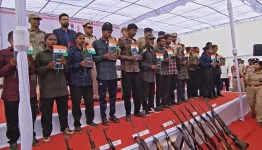
Wednesday, officials said. Besides a huge stock of weapons, Rs 3.61 crore in cash and one kg of gold valued at about Rs 1.64 crore were recovered from Maoist dumps, the highest seizure of cash and valuables from a single location in the history of anti-Naxal operations in the country, Inspector General of Police, Bastar Range, Sundarraj Pattilingam told PTI.
Union Home Minister Amit Shah has set a deadline of March 31 for the eradication of Naxalism from the country.
Among the surrendered Naxalites, six were divisional committee members carrying a reward of Rs 8 lakh each, as per officials.
The cadres, belonging to the Dandakaranya Special Zonal Committee (DKSZC) of Maoists, turned themselves in at Jagdalpur, the Bastar district headquarters, Pattilingam said.
DKSZC formation of outlawed CPI (Maoists) orchestrated several deadly attacks in south Bastar in the past.
Information provided by the surrendered cadres helped security forces achieve significant successes, including the recovery of weapons, cash and other materials from Maoist dumps, the official said.
A total of 101 weapons were seized, including AK-47, INSAS and SLR rifles, light machine guns, .303 rifles and barrel grenade launchers, dealing a significant blow to the already weakened military capability of the Maoist organisation, Pattilingam said.
Among those who surrendered were several key cadres, including divisional committee members Rahul Telam, Pandru Kovasi and Jhitru Oyam from the West Bastar division, Ramdhar alias Biru from the East Bastar division and Mallesh from the North Bastar division.
Others included Muchaki, commander of the People’s Liberation Guerrilla Army (PLGA) battalion, and Kosa Mandavi, a divisional committee member from the Andhra-Odisha Border area of Maoists, the official said.
The large-scale surrender indicated that Maoist ideology was weakening and even members within the organisation were questioning its relevance, Pattilingam said.
He said many cadres were influenced by the “Poona Margem – Rehabilitation to Rejuvenation” initiative and were choosing to abandon violence and return to mainstream society.
Efforts are being made under the rehabilitation policies of the Centre and the Chhattisgarh government to ensure security and a dignified life for the surrendered cadres, the official said.
Of the 108 surrendered cadres, six were divisional committee members, three company platoon committee commanders, 18 platoon party committee members, 23 area committee members and 56 party members, Deputy Chief Minister Vijay Sharma told reporters in Raipur.
District-wise, 37 Maoists belonged from Bijapur, 30 were from Dantewada, 18 from Sukma, 16 from Bastar, four from Narayanpur and three from Kanker.
The government aimed to eliminate Naxalism by March 31, said Sharma, who holds charge of the state Home department.
Maoists were increasingly abandoning violence due to sustained security operations and the government’s rehabilitation policy, which offers them an opportunity to lead a peaceful life, he said.
According to police, 2,714 Maoist cadres have returned to the mainstream in the state over the past 26 months after giving up violence.
In the Bastar division alone, 2,625 Maoists surrendered between January 1, 2024 and March 9, 2026.