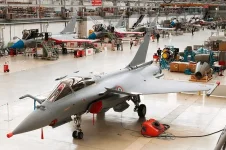
In a major development for India’s aerial combat capabilities, French aviation giant Dassault Aviation has been directed to submit a comprehensive formal proposal by late April 2026 for the supply of 114 Rafale fighter jets.
This request follows the recent "Acceptance of Necessity" (AoN) granted by the Defence Acquisition Council (DAC), chaired by Defence Minister Rajnath Singh, effectively greenlighting one of the world's most significant military procurement programmes.
Strategic Shift Toward Domestic Production
The multi-role fighter aircraft (MRFA) project, estimated to be worth at least Rs 2.5 lakh crore, marks a transition from simple acquisition to deep industrial partnership.While the 2016 deal for 36 aircraft was primarily a direct purchase, this new agreement envisions that at least 96 of the 114 jets will be manufactured within India.
Dassault’s upcoming bid must provide exhaustive details on:
- Cost Efficiency: Comprehensive pricing for the entire fleet.
- Technology Transfer (ToT): Mechanisms to share sensitive aerospace know-how.
- Industrial Architecture: A roadmap for establishing a Final Assembly Line (FAL) on Indian soil.
- Localisation: Plans to achieve a high percentage of indigenous content, targeting a 50–60% indigenisation rate.
Expanding the Indian Aerospace Ecosystem
The project is expected to go beyond mere assembly, fostering a robust domestic vendor network. Industry reports suggest that Tata Advanced Systems Limited (TASL) and Dassault Reliance Aerospace Limited (DRAL) in Nagpur will play pivotal roles.TASL is already preparing to produce fuselage sections, while Safran, the engine manufacturer, is establishing a dedicated Maintenance, Repair, and Overhaul (MRO) facility in Hyderabad for the M88 engines.
| Feature | Details |
|---|---|
| Total Aircraft | 114 Rafale Fighters |
| Manufacturing Plan | 18 off-the-shelf; 96 Made in India |
| Projected Timeline | Contract finalisation by March 2027 |
| Current Squadron Strength | ~29-31 (Target: 42) |
Addressing Critical Operational Gaps
The Indian Air Force (IAF) currently operates roughly 29 to 31 fighter squadrons, significantly below the sanctioned strength of 42.With the impending retirement of ageing MiG-29 and Jaguar fleets, the 114 Rafale jets are viewed as a "force multiplier" essential for maintaining regional parity.
Unlike previous iterations, this deal is being structured as a direct government-to-government (G2G) agreement with active involvement from the manufacturer. This ensures sovereign-level guarantees for delivery while allowing Dassault to lead the industrial setup.
Negotiations are also expected to focus on the integration of indigenous weaponry, such as the Astra beyond-visual-range missile, and potential access to the aircraft’s software source code to ensure long-term strategic autonomy.
If the evaluation by the Cost Negotiation Committee stays on schedule, a formal contract could be signed by the end of the 2026-27 financial year, with deliveries potentially commencing by 2030.