As India advances its capabilities in stealth-focused aerial combat, the Defence Research and Development Organisation (DRDO) is engineering a highly specialised version of the Astra Mk2 air-to-air missile.
This new variant features folding fins specifically designed to fit inside the internal weapons bays of next-generation stealth aircraft.
Recognised as a high-priority initiative, this development is crucial for keeping the radar signatures of advanced platforms like the Advanced Medium Combat Aircraft (AMCA) and the Ghatak Unmanned Combat Aerial Vehicle (UCAV) to an absolute minimum while ensuring they remain heavily armed.
Overcoming the Stealth Challenge
The primary obstacle in designing a stealth fighter is maintaining a smooth exterior to avoid radar detection.Traditional air-to-air missiles possess fixed fins that take up a substantial amount of room, severely limiting the number of weapons that can be stored inside a stealth jet's internal bay.
To overcome this hurdle, the DRDO has innovated a spring-loaded fin system for the Astra Mk2.
These fins remain folded flat against the missile's body during storage and automatically snap open the moment the weapon is dropped into the air currents during a launch.
Boosting AMCA's Internal Firepower
This structural tweak brings a massive advantage to the battlefield.Because the folding fins drastically reduce the space each missile occupies, the AMCA is now projected to house up to six Astra Mk2 missiles internally.
This is a significant upgrade from initial estimates, which capped the internal payload at just four missiles.
Consequently, the fighter jet can carry out missions with significantly greater firepower while remaining completely invisible to enemy radar, giving pilots the ability to engage multiple targets safely.
To make this a reality, the Aeronautical Development Agency (ADA) is working closely with the DRDO to perfectly size the AMCA’s internal weapons bay for the new missile dimensions.
Crucial high-speed separation tests, which ensure the missile can be safely dropped at supersonic speeds without striking the aircraft, were successfully wrapped up in late 2025.
Expanding to the Ghatak UCAV
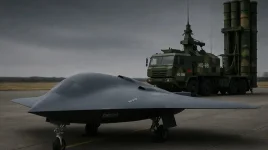
Simultaneously, engineers are outfitting the Ghatak UCAV—a stealthy, flying-wing drone officially known as the Remotely Piloted Strike Aircraft—with the same folding-fin technology.The Ghatak will carry these modified Astra Mk2 missiles internally to protect itself and neutralise airborne threats during deep penetration strikes into hostile territory.
The timeline for bringing these weapons to the Ghatak has been notably fast-tracked following the Defence Acquisition Council’s (DAC) approval to acquire four squadrons of the drone in March 2026.
Astra Mk2: A Technological Leap
Beyond its new physical profile, the Astra Mk2 offers formidable combat performance.It is driven by a dual-pulse solid rocket motor that pushes its strike range to between 160 and 200 kilometres.
The second pulse of the motor activates during the final approach, giving the missile the extra speed and energy required to outmanoeuvre and destroy evasive targets.
Furthermore, the integration of a home-grown Ku-band active radar seeker highlights India's ongoing commitment to self-reliance in cutting-edge defence manufacturing.
Looking Ahead: The Astra Mk3 'Gandiva'
The innovative folding-fin design is also paving the way for India's next frontier in missile technology: the Astra Mk3, widely known as the "Gandiva". Engineered from the ground up for stealth platforms, the Gandiva utilises an advanced Solid Fuel Ducted Ramjet (SFDR) propulsion system.According to recent updates from April 2026, the DRDO has already conducted successful flight tests of the SFDR engine from the Integrated Test Range in Chandipur.
This cutting-edge propulsion technology allows the Gandiva to dynamically adjust its thrust, sustain supersonic speeds up to Mach 4.5, and strike high-value targets—such as airborne early warning and control (AWACS) aircraft and mid-air refuellers—at extreme distances of 300 to 350 kilometres.