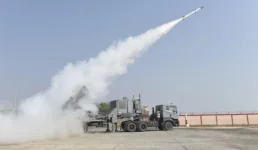
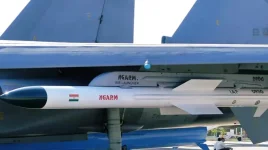
India’s indigenous air combat capabilities are on the verge of a significant transformation. The Defence Research and Development Organisation (DRDO) is preparing to issue production clearance for the Astra Mk2 air-to-air missile later this year.
In a development that has exceeded initial expectations, the missile has demonstrated capabilities far superior to its original design parameters.
While the Astra Mk2 was originally conceptualised to strike targets at a distance of 160 km, updated performance evaluations indicate it can effectively engage threats at a range of approximately 220 km.
This enhancement firmly positions the indigenous weapon in the elite category of long-range aerial warfare systems.
From Incremental Upgrade to Strategic Asset
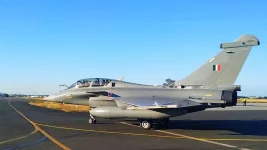
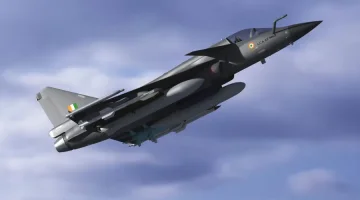
The substantial increase in range is more than just a statistical improvement; it fundamentally alters the Indian Air Force’s (IAF) engagement strategy. The extended reach allows the Astra Mk2 to serve as the primary long-range weapon across the IAF’s diverse fighter fleet.According to defence sources, the missile is being integrated onto a wide variety of aircraft, including the Russian-origin Su-30MKI and MiG-29, as well as the indigenous Tejas Mk1A and the French-origin Rafale.
This move towards a single, standard beyond-visual-range (BVR) missile for both Western and Russian platforms represents a rare and highly efficient level of fleet standardisation.
Advanced Propulsion Technology
The significant range extension of the Astra Mk2 is largely attributed to its advanced propulsion system.Unlike its predecessor, the Astra Mk1, which uses a conventional solid-fuel motor, the Mk2 variant is powered by a dual-pulse solid rocket motor.
This technology allows the missile to manage its fuel burn more intelligently—firing an initial pulse to accelerate and a second pulse later in flight to maintain high speed during the terminal phase.
This ensures the missile retains sufficient energy to manoeuvre and intercept agile enemy aircraft even at extreme ranges, a capability comparable to advanced global systems like the Meteor and PL-15.
Massive Production and Private Sector Participation
Reflecting the missile's central role in future air operations, the IAF is projected to place one of the largest single orders for air-to-air missiles in its history.Sources suggest that the total requirement could exceed 500 units once formal clearance is granted.
To accommodate this massive scale and ensure a robust supply chain, the DRDO is moving away from a single-manufacturer model.
Plans are being finalised to engage two distinct production partners.
While the state-owned Bharat Dynamics Limited (BDL) is expected to be the lead integrator, a private sector defence firm will likely serve as the second production line, ensuring capacity resilience and faster delivery.
Upcoming Trials and Integration
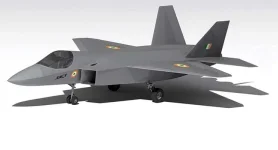
The development programme is currently in a critical phase of testing and integration.The DRDO is scheduled to conduct firing trials of the Astra Mk2 from the Tejas Mk1A fighter later this year, which is a prerequisite for final operational clearance.
Simultaneously, work is progressing to integrate the missile with the Rafale fleet. Successful integration on the Rafale would be a landmark achievement, proving India’s ability to network indigenous weaponry with sophisticated foreign avionics.
Furthermore, the missile is being adapted for the Indian Navy’s MiG-29K fighters, expanding its operational footprint to carrier-based maritime aviation.
A Shift Towards Self-Reliance
Strategically, the maturation of the Astra Mk2 comes at a crucial time as India seeks to minimise its reliance on foreign defence imports.Historically, the IAF has had to depend on platform-specific missiles that come with geopolitical strings and complex supply chains.
The arrival of a domestic missile with performance equal to or better than imported equivalents offers the IAF operational freedom and immunity from external supply shocks.
If the current timelines are met, the Astra Mk2 will transition from a developmental project to a mass-produced reality within the next year.
By becoming the backbone of the IAF’s air-to-air arsenal, the missile signals that India is no longer seeking mere parity but is aiming for decisive technological autonomy in aerial combat.