- Views: 322
- Replies: 3
The Sukhoi Su-30MKI has long stood as the undisputed heavyweight champion of the Indian Air Force (IAF), serving as the backbone of our aerial defence network.
However, in an era increasingly dominated by fifth-generation platforms, the massive frame and traditional aerodynamics of this heavy air superiority fighter present a glaring vulnerability: a radar cross-section (RCS) that lights up enemy screens.
As the Ministry of Defence clears the highly anticipated 'Super Sukhoi' upgrade programme for an initial 84 aircraft, a critical debate has emerged regarding the platform's future survivability.
Some purists argue for a radical, structural overhaul to make the aircraft truly stealthy.
But let us be clear: attempting to convert the Su-30MKI into a full stealth fighter is not only an engineering nightmare, but it is also a financially imprudent exercise.
Instead, the IAF and the Defence Research and Development Organisation (DRDO) are pursuing a far smarter, more pragmatic philosophy: selective RCS reduction combined with overwhelming sensor and electronic warfare (EW) superiority.
The Fallacy of the Stealth Sukhoi
To truly hide an aircraft as large as the Su-30MKI from enemy radars, one would need to completely alter its base geometry.You would have to redesign the airframe to house an internal weapons bay, as the external carriage of missiles, pylons, and fuel tanks act as giant radar reflectors.
Attempting such a drastic structural transformation would effectively require building an entirely new aircraft from scratch. It is a bridge too far for a legacy airframe.
The Pragmatic Path: Selective RCS Reduction
The more realistic approach is to accept the airframe's inherent geometric limitations and aggressively target the specific areas that scatter the most electromagnetic energy.DRDO has successfully developed indigenous Radar Absorbing Materials (RAM) and magnetic functional fillers. Rather than attempting to coat the entire massive jet in expensive, high-maintenance paint, this technology is best applied strategically.
Applying RAM to the notoriously reflective engine intake ducts, wing leading edges, and canards can significantly shave down the aircraft's frontal radar signature.
Furthermore, replacing non-load-bearing access panels and fairings with radar-absorbing composite materials offers a permanent reduction in visibility.
The canopy and the radome are equally critical areas; applying specialised conductive treatments to the canopy and utilising controlled materials for the radome can prevent enemy radar waves from bouncing off the cockpit cavity and internal radar dishes without blinding the jet's own sensors.
Sensors and EW: The Best Form of Defence
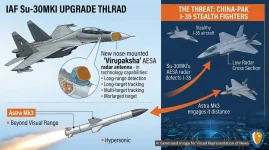
While selective RCS reduction makes the Su-30MKI harder to track, it is the avionics that will make it lethal to engage.The heart of the Super Sukhoi upgrade is the indigenous Virupaksha Active Electronically Scanned Array (AESA) radar.
Built on cutting-edge Gallium Nitride (GaN) semiconductor technology and boasting roughly 2,400 Transmit/Receive modules, this sensor represents a monumental generational leap forward.
When you pair the Virupaksha radar with a next-generation indigenous EW suite and advanced infrared search and track (IRST) systems, the paradigm of survivability shifts entirely.
In modern network-centric warfare, an aircraft does not necessarily need to be completely invisible.
It simply needs to detect the enemy first, blind their sensors using overpowering EW jamming, and launch long-range weapons—such as the Astra Mk3 missile—before the adversary can establish a successful kill chain.
A Sustainable Upgrade Strategy
Perhaps the greatest advantage of this selective approach is logistical.India can implement these RAM treatments, composite swaps, and avionics upgrades incrementally during the scheduled, routine maintenance and overhaul cycles at Hindustan Aeronautics Limited (HAL).
This ensures that the IAF does not have to pull a massive chunk of its frontline fighters out of active service for years at a time for major structural rebuilds.
Ultimately, we do not need to forcibly mutate the Su-30MKI into an F-35 equivalent.
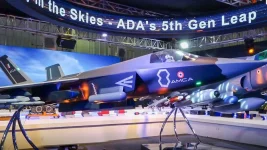
As India patiently develops a true low-observable platform in the Advanced Medium Combat Aircraft (AMCA), outfitting a "selectively lower-observable" Su-30MKI with world-class AESA radars, ferocious EW capabilities, and long-range missiles is a masterclass in tactical pragmatism.
It guarantees that our heavy fighter will not just survive, but dominate the skies for decades to come.