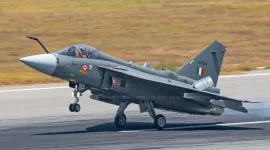
A recent photograph of a Tejas Mk1A airframe has sparked significant interest within the Indian defence and aviation communities, offering visible proof of steady manufacturing progress at Hindustan Aeronautics Limited (HAL).
The image, shared on the social media platform X by the handle @FighterPiloting, depicts airframe LA-5051 stationed in an outdoor testing facility.
While the aircraft appears to be in an advanced stage of assembly, it is not yet fully finished. If the production sequence remains consistent with the initial aircraft, LA-5033, this specific airframe represents the 19th unit in the current manufacturing batch of India’s advanced light fighter.
The photograph provides a rare and informative glimpse into the critical intermediate phase where a fighter jet transitions from a static structure to a fully integrated system.
The aircraft is devoid of its final operational paint scheme, sporting instead the characteristic yellow-green primer used on newly assembled aviation structures.
This visual evidence offers observers a clear understanding of the evolution of a modern combat platform, bridging the gap between raw fabrication and a frontline-ready machine.
The distinct primer coating visible on the fuselage serves as a vital protective layer applied immediately following the completion of major structural assembly.
The presence of this coating confirms that LA-5051 has successfully cleared several key manufacturing milestones, including the joining of the fuselage sections, the integration of the wings, and the installation of the landing gear.
Essentially, the structural skeleton of the fighter is complete, and the primer is now shielding the composite and metallic surfaces from environmental corrosion and contamination while technicians proceed with internal installations.
Further inspection of the image reveals open panels and exposed internal sections, suggesting that the aircraft is undergoing intensive systems integration. This phase likely involves the routing of complex avionics wiring, hydraulic line verification, and the connection of flight-control mechanisms.
Before a modern fighter can be sealed, it must pass rigorous subsystem verification to ensure that every sensor, actuator, and control channel operates within strict tolerances.
The presence of maintenance stands and wheel chocks around the airframe indicates that it is currently in a controlled testing environment rather than a flight-ready state.
A significant indicator of progress is the fully installed landing gear.
The fitment of the undercarriage typically marks the point where an airframe achieves structural maturity, enabling it to be moved between hangars for various stages of systems testing.
At this juncture, engineers generally commence a series of progressive functional checks—ranging from power distribution tests to cockpit instrumentation reviews—which establish the necessary foundation for future engine ground runs and low-speed taxi trials.
Production Context and Engine Delays
While the appearance of the 19th airframe underscores HAL’s ability to manufacture airframes at a steady pace, the Tejas Mk1A programme continues to face challenges regarding final delivery.Recent open-source reporting indicates that while HAL has successfully built multiple airframes, the delivery schedule has been impacted by delays in the supply of F404 engines from US-based manufacturer GE Aerospace.
Reports from early February 2026 suggest that HAL has at least five aircraft fully ready for delivery and another nine structurally complete airframes awaiting engines.
The sighting of LA-5051 confirms that HAL’s production line is moving faster than the supply chain can support, creating a backlog of airframes ready for their powerplants.
The Indian Air Force is expected to conduct a comprehensive review of the programme later this year to assess the timeline for operational induction.