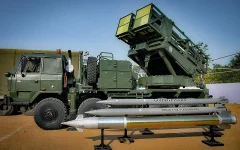
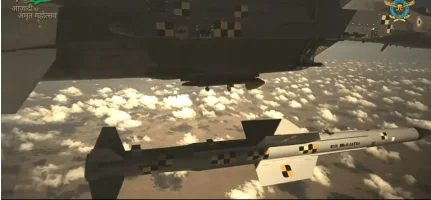
The Defence Research and Development Organisation (DRDO) has achieved a massive breakthrough that shifts India’s hypersonic programme from experimental research to the production of combat-ready weapons.
On January 9, 2026, at the Defence Research and Development Laboratory (DRDL) in Hyderabad, scientists successfully conducted a ground test of a full-scale, actively cooled scramjet engine for over 12 minutes.
This event is not merely a laboratory success; it is a decisive turning point. By sustaining a burn for a duration that mirrors a real-world flight profile, India has effectively signalled that it is ready to move from technology demonstration to the weaponisation and flight-testing phase.
Why Duration Matters
In the world of hypersonic flight, the ability to keep an engine running is the ultimate challenge. Igniting an engine at speeds of Mach 6 or 7 is difficult, but keeping it stable is even harder.A scramjet that can manage extreme heat, maintain combustion, and produce thrust continuously for twelve minutes is no longer just a science project. It is a mature propulsion system ready for integration into a missile.
Three Key Milestones
This specific test at the Scramjet Connect Pipe Test (SCPT) facility confirms three major realities for India’s defence capabilities:- Beyond the Concept Phase: India has moved past basic demonstrations. While earlier trials proved that the technology works in short bursts, this long-duration burn provides the missing piece: endurance. The 12-minute runtime proves the engine can power a missile through its entire midcourse cruise phase.
- Ready for Weaponisation: A ground test of this length is the final engineering checkpoint before a missile is taken to the skies. No country moves to air-drop or booster-launch trials until the engine proves it can survive the stress of sustained operation on the ground.
- Reliability is Proven: The test validated "active cooling," which is the most difficult aspect of hypersonic engineering. At Mach 7, air friction heats the missile skin to over 1,000°C, which would normally melt the engine. This test confirmed that India has mastered the technology where the fuel itself acts as a coolant before being burned, solving the problems of heat and structural survival.
Calculating the Strike Range
The implications of a 12-minute burn time are vast when translated into strike range. Hypersonic cruise missiles operate on a basic physics formula: Distance = Speed × Time.- Speed: A scramjet cruising at Mach 6 to Mach 7 travels at approximately 7,400 km/h.
- Time: Twelve minutes is equal to 0.2 hours.
- Result: 7,400 km/h × 0.2 hours = 1,480 km of powered flight.
Strategic Advantage
Unlike ballistic missiles that follow a predictable arch, scramjet-powered cruise missiles fly within the atmosphere. They can manoeuvre at low altitudes and high speeds, making them nearly impossible for enemy radars to detect or intercept.This capability fills a critical gap in India’s arsenal. It provides a precision strike option that sits between the supersonic BrahMos and strategic ballistic missiles. Such a weapon can strike time-sensitive targets deep within adversary territory—across the Tibetan plateau or the Indo-Pacific—without crossing the nuclear threshold.
With this test, India joins an elite group of nations—including the US, Russia, and China—that have mastered the engineering required for sustained hypersonic flight. The focus is no longer on chasing the technology; the focus is now on building deployable weapons.