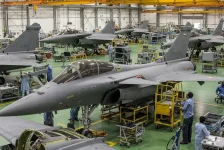
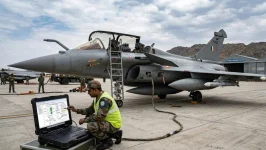
India is considering the establishment of a second final assembly line for Rafale fighter jets in Hyderabad. This development is contingent upon the government finalising a substantial order for 114 additional multi-role combat aircraft.
According to reports from Aviation Week, the French aerospace giant Dassault Aviation has proposed this facility as a cornerstone of its industrial strategy for the upcoming procurement.
Strategic Expansion of Air Power
The Indian Air Force's (IAF) Multi-Role Fighter Aircraft (MRFA) programme recently reached a major milestone when the Defence Acquisition Council (DAC) granted official clearance for the 114-jet acquisition.If the contract is signed, it will rank among the most significant defence procurement initiatives in India's modern history.
The project aims to address the critical decline in the IAF's squadron strength, which currently sits at approximately 29 squadrons against a sanctioned requirement of 42.
Local Manufacturing and Industrial Goals
Éric Trappier, Chairman and CEO of Dassault Aviation, confirmed the company’s readiness to launch the Hyderabad assembly line once the order is secured.While the exact production capacity for this new site is yet to be finalised, the primary objective is to maximise the volume of aircraft manufactured on Indian soil.
This new facility would build upon existing industrial roots in India. Currently, several domestic firms are already involved in producing Rafale components.
By moving to a full local assembly model, India aims to cultivate a self-sustaining aerospace ecosystem and reduce its dependence on foreign-made military hardware.
| Feature | Details |
|---|---|
| Total Aircraft | 114 Rafale Fighters |
| Production Model | 18 Flyaway (from France), 96 Made-in-India |
| Localisation Target | Minimum 50% indigenous content |
| Estimated Value | Approximately ₹3.25 lakh crore ($36 billion) |
| Key Partners | Dassault Aviation, Tata Advanced Systems, DRAL |
Indigenous Content and Global Ambitions
A central requirement for this deal is a high degree of localisation.Defence Secretary Rajesh Kumar Singh recently specified that India is targeting an indigenous content level exceeding 50% for the aircraft produced domestically.
This involves:
- Integrating indigenous weaponry such as the Astra and Rudram missiles.
- Sourcing subsystems and structural components from a network of over 40 Indian suppliers.
- Expanding technology transfer to ensure long-term maintenance and upgrade autonomy.
This would position India as a regional hub for Rafale maintenance, potentially serving international operators in the Middle East and the Indo-Pacific.