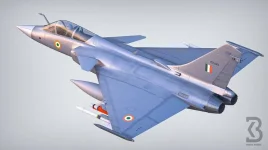
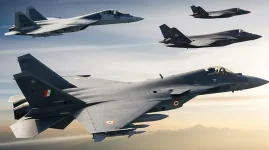
The Indian Air Force (IAF) has decided against placing follow-on orders for the Tejas Mk1A fighter jet beyond the recently concluded contracts, signalling a strategic shift towards stabilizing current inductions and accelerating the development of the more advanced Tejas Mk2.
Following the recent approval for 97 additional Tejas Mk1A jets, the total order book for the Light Combat Aircraft (LCA) programme—comprising earlier Mk1 and Mk1A deals—now stands at 220 aircraft.
This significant expansion had sparked speculation within the defence industry that the IAF might look to acquire even more Mk1A units to rapidly address its depleting squadron strength. However, senior officials have now confirmed that no such proposal is currently on the table.
Focus on Delivery and Operationalisation
Speaking to defence analysts, a senior IAF official clarified that the service has no immediate plans to expand the Mk1A procurement beyond the 97 aircraft recently contracted. The official emphasised that the current priority is to ensure the smooth delivery and operationalisation of the jets already ordered."The order for 97 aircraft was placed recently. Our primary focus now is to see these aircraft delivered and integrated into our combat fleet," the official stated.
While the IAF has not permanently ruled out future acquisitions, any decision to buy more Mk1A fighters would only be taken if a specific operational necessity arises in the future.
Supply Chain Challenges and Delays
A key factor influencing this pause is the delay in the delivery of the first batch of 83 Tejas Mk1A jets, a deal signed in 2021 which included 73 single-seat fighters.The programme has faced headwinds due to global supply chain constraints, specifically regarding the delivery of GE F404 engines from the United States. These delays have pushed the induction timeline back, with the first production aircraft yet to be handed over to the Air Force.
Consequently, the IAF is keen to evaluate the actual delivery pace and operational performance of the Mk1A fleet before committing to further numbers. The service aims to avoid an accumulation of orders without a corresponding rate of delivery.
Production Targets and the Tejas Mk2 Transition
Hindustan Aeronautics Limited (HAL) has outlined a production roadmap that projects peak deliveries of the Tejas Mk1A around the 2028–29 timeframe.By this period, HAL targets an annual production rate of 24 to 30 aircraft. However, this timeline coincides with the expected maturation of the next-generation Tejas Mk2 programme.
The Tejas Mk2, a larger medium-weight fighter powered by the more powerful GE F414 engine, is designed to offer significantly greater range, payload capacity, and combat capabilities compared to the Mk1A.
The Mk2 is scheduled to make its maiden flight in 2027, with the programme expected to gain substantial momentum just as Mk1A deliveries peak.
Future Force Structure
The IAF has already provided a firm commitment for 120 Tejas Mk2 aircraft. Defence sources suggest that this requirement could eventually expand to nearly 220 units, contingent on the Air Force’s long-term force structure requirements and evolving threat assessments in the region.With the Tejas Mk2 positioned to become the backbone of the IAF’s indigenous medium-weight fighter fleet in the 2030s, the service is gradually pivoting its attention and resources to ensure this critical platform is developed and inducted without further delays.