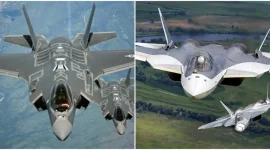
India has decided not to move forward immediately with proposals from the United States or Russia for fifth-generation combat aircraft, choosing instead to prioritise its domestic stealth fighter programme.
During an appearance at the Rising Bharat Summit 2026, Defence Secretary Rajesh Kumar Singh clarified that the nation’s primary objective in this category is the development of the HAL Advanced Medium Combat Aircraft (AMCA).
The Secretary’s comments come amid intense competition from international aerospace firms eager to supply the Indian Air Force (IAF).
Although both American and Russian manufacturers have presented their advanced platforms as solutions for India’s long-term security needs, the government has signalled that it will not be pressured into a hasty foreign purchase.
"Our fifth-generation fighter will be the HAL AMCA. We haven’t taken a call yet on Russian or American offers," Singh stated, reaffirming a strategic commitment to "Aatmanirbharta" (self-reliance) in the defence sector.
A Multi-Layered Fleet Strategy
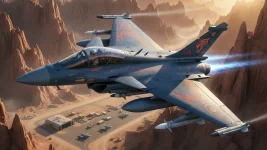
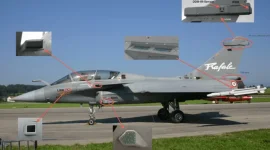
While the 5th-generation requirements are being met through indigenous channels, the government is addressing immediate operational gaps through the Multi-Role Fighter Aircraft (MRFA) programme.Under this initiative, India has indicated a strong preference for the Dassault Rafale. The plan involves procuring 114 jets to bolster the IAF's declining squadron numbers, which have been impacted by the retirement of older aircraft.
Crucially, any agreement under the MRFA will necessitate extensive local manufacturing. The Defence Secretary noted that modern acquisitions are strictly tied to:
- Technology Transfer: Ensuring the "brain" of the aircraft can be understood and maintained locally.
- Indigenous Content: Increasing the percentage of Indian-made components over the life of the contract.
- Industrial Growth: Building a robust domestic ecosystem for long-term maintenance and upgrades.
Strategic Context and Open-Source Updates
Recent reports from early 2026 suggest a significant shift in the execution of the AMCA project.To ensure agility and meet the target of a first flight by 2029, the government has reportedly shortlisted private-sector consortia—including Tata Advanced Systems, Larsen & Toubro, and Bharat Forge—to lead the development of prototypes.
This marks a departure from the traditional model where state-run Hindustan Aeronautics Limited (HAL) held exclusive leadership, though HAL is expected to remain a vital partner in serial production.
Additionally, while the official stance remains focused on the AMCA, some analysts suggest India may still consider a "stopgap" acquisition of a small number of Sukhoi Su-57 aircraft from Russia or F-35 jets from the US if regional threats, such as China’s expanding J-20 fleet, intensify before the AMCA is ready for induction in the mid-2030s.
By maintaining this calibrated approach, India aims to balance its urgent need for modern air power with the long-term goal of owning the intellectual property and design rights for its frontline defence platforms.