In a significant move to secure the skies over the nation's capital, India is set to deploy a dedicated, multi-layered air defence architecture informally known as the "Capital Dome".
This ambitious project aims to shield New Delhi from a vast spectrum of aerial threats, ranging from high-speed missiles to low-cost hostile drones, by creating an impenetrable defensive envelope over the National Capital Region (NCR).
A Multi-Layered Indigenous Shield
According to defence sources, the Capital Dome will primarily rely on indigenous technologies developed by the Defence Research and Development Organisation (DRDO).Unlike previous reliance on foreign systems, this architecture integrates Made-in-India solutions to provide 24/7 protection against both external military aggression and asymmetric threats launched from within or near the city.
The system is designed as a networked "shield" that combines different interceptors to handle threats at various ranges and altitudes.
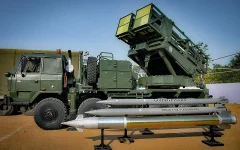
Central to this network are two advanced missile systems: the Quick Reaction Surface-to-Air Missile (QRSAM) and the Vertically Launched Short Range Surface-to-Air Missile (VL-SRSAM).
QRSAM and VL-SRSAM: The Kinetic Core
The Quick Reaction Surface-to-Air Missile (QRSAM) will serve as a highly mobile component of the defence grid.Mounted on 8x8 heavy mobility vehicles, the QRSAM is capable of "search-on-move" and "track-on-move" operations, meaning it can detect and lock onto targets even while repositioning.
With a range of approximately 25–30 km, it is specifically designed to neutralise low-flying threats such as cruise missiles, helicopters, and fighter aircraft with rapid reaction times.
Complementing this is the VL-SRSAM, originally developed for the Indian Navy but now adapted for ground-based air defence.
Its key advantage lies in its vertical launch capability, which allows it to engage targets in any direction (360 degrees) without the mechanical delay of swivelling a launcher.
In a dense urban environment like Delhi, where threats could emerge from any quadrant, this omnidirectional capability is vital. The VL-SRSAM is based on the proven Astra air-to-air missile technology and features active radar homing for high-precision interception.
Lasers Against Drones: The Directed Energy Edge
A standout feature of the Capital Dome is the integration of Directed Energy Weapons (DEWs).As the usage of small, commercial-grade drones for surveillance and sabotage grows globally, traditional missiles often prove too expensive or risky to use against such small targets in populated areas.
DEWs, including high-energy laser systems and high-power microwave devices, offer a "soft kill" or "hard kill" capability. They can disable a drone's electronics or physically burn through its airframe at the speed of light.
These systems provide a deep magazine—limited only by power supply—and significantly reduce the risk of collateral damage caused by falling missile debris, making them ideal for the heart of the capital.
Integrated Command and Control
The efficacy of the Capital Dome relies on its networked nature. An array of radars, electro-optical sensors, and communication hubs will feed into a central command-and-control system.This integrated air picture allows the system to automatically assign the best weapon to a specific threat—using lasers for small drones and missiles for larger, faster targets—ensuring a seamless handover between defensive layers.
Once fully operational, the Capital Dome will transform New Delhi into one of the most heavily fortified cities in the region, underscoring India's shift towards self-reliance in critical strategic defence technologies.