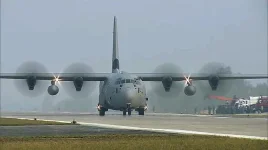
US aerospace giant Lockheed Martin has formally outlined a comprehensive "Make in India" proposal for its C-130J Super Hercules transport aircraft.
The company has committed to establishing a phased manufacturing and sustainment ecosystem within the country, contingent upon the aircraft’s selection for India’s future tactical airlift requirements, specifically the Indian Air Force’s (IAF) Medium Transport Aircraft (MTA) programme.
A Phased Transition from Georgia to India
Senior Lockheed Martin officials have detailed a strategy that balances immediate delivery needs with long-term indigenisation goals.Under this proposal, the initial batch of aircraft for the Indian contract would be assembled at the company’s global production hub in Marietta, Georgia, USA.
This ensures that the IAF can begin inducting the aircraft without delay.
As the programme matures, the manufacturing process would progressively shift to a new, dedicated assembly line in India.
Lockheed Martin has stated that the location of this new Indian facility would be decided in strict consultation with the Government of India, aligning with New Delhi's regional industrial development preferences.
Importantly, officials clarified that the establishment of the Indian line would not reduce the capacity of the US facility.
The Marietta plant, which currently churns out between 20 and 24 aircraft annually, would continue to serve other global customers.
Simultaneously, the Indian facility would ramp up to support domestic needs, with the option to accelerate production rates if the IAF requires faster delivery schedules.
Strategic Context: The MTA Programme
This manufacturing proposal is pitched directly at the Indian Air Force's Medium Transport Aircraft (MTA) tender, a significant procurement programme aimed at replacing the ageing fleet of Soviet-era Antonov An-32 and Ilyushin Il-76 transport planes.The IAF is looking to acquire between 40 and 80 aircraft in the 18–30 tonne payload class.
Lockheed Martin’s C-130J-30 is a strong contender in this race, competing against Embraer’s C-390 Millennium (partnered with Mahindra) and Airbus’s A400M (partnered with Tata).
Lockheed’s pitch relies heavily on the "proven platform" argument, citing the IAF's existing familiarity with the Super Hercules. The IAF currently operates a fleet of 12 C-130J-30s, inducted in two batches, which are utilised for special operations and tactical airlift.
Deepening the Industrial Base: MRO and Manufacturing
The proposal is bolstered by Lockheed Martin’s existing industrial footprint in India, which is deeper than that of many competitors.The company has a long-standing joint venture with Tata Advanced Systems Limited (TASL) — Tata Lockheed Martin Aerostructures Limited (TLMAL) in Hyderabad.
This facility already serves as the sole global supplier of empennages (tail assemblies) for every C-130J manufactured worldwide, demonstrating that critical components are already "Made in India".
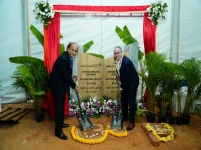
Complementing the manufacturing bid, Lockheed Martin and TASL have also commenced work on a comprehensive sustainment infrastructure. A ground-breaking ceremony was recently held in Bengaluru for a new Maintenance, Repair, and Overhaul (MRO) facility.
Expected to be operational by 2026, this MRO centre will initially support the IAF's current fleet of 12 Super Hercules aircraft. Its establishment will significantly reduce the turnaround time for repairs and cut dependence on foreign support facilities.
In the long term, Lockheed Martin envisions this Bengaluru site evolving into a regional hub, capable of servicing C-130J fleets from other nations in the Indo-Pacific region.
Path to Self-Reliance
The combination of a phased manufacturing transition and a domestic MRO ecosystem represents a significant deepening of Lockheed Martin’s commitment to India.For the Ministry of Defence, the plan offers a viable pathway to "Atmanirbhar Bharat" in the defence sector.
It promises to deliver not just hardware, but also the critical industrial capability to produce and sustain tactical airlifters within the country for decades to come.