American aerospace major Lockheed Martin has revealed its readiness to supply a specifically adapted variant of its C-130J Super Hercules to fulfil the Indian Air Force’s (IAF) Medium Transport Aircraft (MTA) needs.
While keeping exact technical configurations under wraps due to fierce competition, the manufacturer is clearly aiming to provide an aircraft that perfectly matches India's unique geographical and operational requirements.
In doing so, the company plans to heavily rely on its well-established manufacturing presence within the country.
During recent discussions, Lockheed Martin highlighted its global track record of modifying aircraft to suit individual buyer demands.
Although specific details were withheld, the defence giant assured that its Indian offering would not only satisfy but potentially surpass the IAF’s stringent guidelines.
This points towards significant adaptability in terms of electronic systems, mission-specific gear, cargo capacity, and overall performance tuning.
According to recent open-source intelligence, Lockheed Martin is actively tailoring the aircraft's digital backbone with an open architecture design to allow local defence firms to seamlessly integrate indigenous avionics and communication suites.
Furthermore, they have reportedly developed a dedicated range-extension kit aimed specifically at allowing the IAF to span the vast Indian Ocean Region without frequent refuelling.
The Indian Air Force is already highly familiar with the C-130J, currently operating a fleet of 12 Super Hercules aircraft from the Hindon and Arjan Singh airbases.
These planes have proven their worth and dependability across severe conditions, from landing at the challenging Daulat Beg Oldie high-altitude airstrip in Ladakh to conducting crucial rescue missions.
This established relationship gives Lockheed Martin a distinct advantage, as they can offer targeted upgrades to a trusted machine rather than asking the IAF to adopt an entirely unfamiliar airframe.
A major component of the American firm's strategy is its robust collaboration with Tata Advanced Systems Limited (TASL), forming one of India's most vital aerospace alliances.
Through joint operations like Tata Lockheed Martin Aerostructures Limited (TLMAL), deep manufacturing roots have already been planted in the domestic sector.
A prime example is that the tail sections—or empennage—for every new C-130J built worldwide are manufactured in Hyderabad.
Over 250 of these units have been shipped so far, boasting an impressive local component rate of over 96 percent.
By leveraging this active domestic supply chain, Lockheed Martin is framing its proposal as a massive boost to the Indian economy rather than a simple military purchase.
The manufacturer points to past investments exceeding $100 million that have directly created roughly 1,700 jobs.
Furthermore, they have fostered a network of 500 local suppliers, which supports another 6,000 workers. Generating almost $1 billion in export revenue, this industrial ecosystem has already proven its financial value to the nation.
To make their bid even more attractive, Lockheed Martin and Tata are currently constructing a specialised Maintenance, Repair, and Overhaul (MRO) centre in Bengaluru.
With its foundation laid in December 2025, this site will maintain the IAF's current Super Hercules planes and eventually act as a support hub for the wider region.
This proactive approach ensures that the necessary infrastructure for long-term upkeep is ready before new orders are even placed, guaranteeing that the fleet remains flight-ready at all times.
Perhaps the most striking promise made by Lockheed Martin is the commitment to build a brand-new final assembly line for the C-130J in India, provided they win the MTA tender.
This would be the first facility of its kind outside the United States, marking a massive shift in how the aircraft is produced globally and turning India into a primary export centre.
The MTA programme, which recently received Acceptance of Necessity (AoN) approval from the Defence Acquisition Council in March 2026, aims to procure 60 aircraft under a "Buy and Make" scheme—where 12 will be purchased ready-to-fly and 48 will be built locally.
Lockheed's blend of shared development and local manufacturing perfectly aligns with this vision for advanced technology transfer and greater domestic business involvement.
Finally, the defence contractor emphasised the worldwide reputation of the C-130J, highlighting its extensive use in a variety of harsh climates and challenging combat zones.
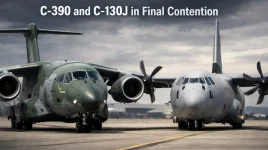
With the Airbus A400M increasingly viewed as too costly and large for the MTA programme, the competition has largely narrowed to a two-way battle between the Super Hercules and Embraer’s jet-powered C-390 Millennium.
As the IAF looks to replace its ageing fleet of over 100 Antonov An-32s, Lockheed Martin is leveraging its proven history to assure Indian decision-makers that its battle-tested platform remains the most reliable choice for tactical airlift, special operations, and disaster relief.