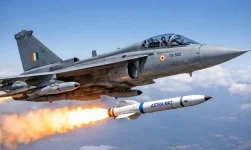
Recent media reports linking the performance upgrades of the Indian Air Force’s Astra air-to-air missile to Chinese PL-15 technology have highlighted the rapid spread of unverified narratives.
Speculation has suggested that the Defence Research and Development Organisation (DRDO) achieved the Astra’s new capabilities by reverse-engineering propellant from a Chinese PL-15E missile allegedly recovered on Indian soil.
However, defence officials and scientists have firmly rejected these claims, pointing to a long-standing indigenous research programme that predates these rumours.
The Reality: Planned Indigenous Development
Contrary to the sensationalist claims of battlefield scavenging, the enhancement of the Astra missile is the result of a formal technical roadmap initiated between 2021 and 2022. This timeline significantly predates the recent wave of speculative stories regarding foreign technology recovery.Ankathi Raju, Chief of the Armament Research and Development Establishment (ARDE), has clarified the specific performance targets currently being validated.
The operational range of the Astra Mk1 is being extended from its original 110 km to approximately 160 km. Meanwhile, the more advanced Astra Mk2 is designed to achieve a range of 220–240 km, up from an initial estimate of 160 km.
These targets were not derived from foreign blueprints but were established through extensive domestic simulation work. Both missile variants utilise new propellant formulations developed entirely in-house by Indian scientists.
They are currently undergoing validation trials to confirm these performance gains under real-world flight conditions.
The Fallacy of Reverse-Engineering Propellant
A persistent narrative has emerged claiming that Indian scientists recovered residue from a used PL-15 rocket motor to duplicate its chemistry.Some accounts even allege a "chain of borrowed chemistry," suggesting that China originally copied US propellant technology, which India is now copying in turn.
Experts note that there is no credible scientific basis for these assertions. Replicating modern missile propellant is not merely a matter of analysing residue.
Solid propulsion involves highly complex chemical formulations, precise grain geometries (the shape in which the fuel is moulded), and specific burn-rate modifiers.
These elements are manufactured using proprietary processes that cannot be reliably reverse-engineered from the remnants of a fired rocket motor.
Scientific Innovation, Not Imitation
The actual method behind the Astra’s range extension is both methodical and transparent.Since 2021, DRDO has focused on developing higher-energy-density propellants. The objective is to create a fuel that burns with greater intensity over a shorter duration.
This innovation is tailored to the Astra’s specific "single-pulse" motor architecture.
Unlike dual-pulse motors that save energy for a later burst, a single-pulse motor expends its energy rapidly to achieve maximum velocity early in the flight.
By improving the energy density, engineers allow the missile to reach a higher peak speed more quickly.
This increased kinetic energy enables the missile to glide for a longer distance after the motor burns out, effectively extending its range without altering the fundamental design of the missile.
Strategic Implications
In practical combat scenarios, this enhancement translates into a larger "no-escape zone"—the area within which an enemy aircraft cannot outrun the missile.The improved propellant ensures the missile retains higher energy during the endgame phase, which is critical for engaging highly manoeuvrable targets.
Attributing this progress to opportunistic copying undermines India’s established expertise in solid rocket propulsion.
DRDO has decades of experience developing motors for ballistic missiles, space launch vehicles, and tactical rockets. The evolution of the Astra family is a natural application of this domestic scientific knowledge base, rather than a sudden leap achieved by stealing technology from an adversary.
As the Astra Mk1 and Mk2 complete their benchmark trials, they are expected to significantly bolster the Indian Air Force’s beyond-visual-range combat capabilities.
The development underscores a clear design philosophy prioritizing speed, glide efficiency, and engagement reach—achieved through sustained R&D rather than foreign reliance.