As the security landscape across the Indo-Pacific and the Himalayan borders becomes increasingly complex, Indian defence planners are re-evaluating the nation’s long-term aerial requirements.
A pivotal debate has emerged regarding whether India should follow its Advanced Medium Combat Aircraft (AMCA) with a standard sixth-generation fighter or pivot toward developing a long-range, manned stealth bomber designed for deep-strike operations.
Accelerating the Future of Flight
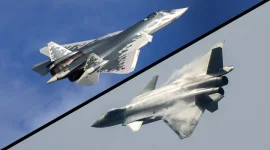
Defence Minister Rajnath Singh recently issued a directive to the Defence Research and Development Organisation (DRDO) to significantly compress development timelines. He has urged scientists to produce sixth-generation aero engines within a five-to-seven-year window.This push for rapid innovation is a direct response to regional developments; China is currently advancing its Xian H-20 stealth bomber and testing next-generation fighter prototypes.
For India, matching this progress is not merely about hardware, but about addressing a strategic gap in a theatre defined by vast distances and sophisticated missile threats.
While a sixth-generation fighter would offer advanced features like directed-energy weapons and AI-driven autonomy, some experts argue a pure fighter may not provide the necessary asymmetrical advantage required to counter Beijing.
Overcoming Geographic Vulnerabilities
A primary concern for the Indian Air Force (IAF) is the vulnerability of forward airbases. China’s long-range missile arsenal, including the DF-21D and DF-26 (often termed "carrier killers"), can target Indian launch facilities near the Line of Actual Control (LAC).A sixth-generation stealth bomber offers a tactical solution to this geographic disadvantage:
- Operating Range: With a projected range of 5,000 km to 12,000 km, these aircraft could be stationed at secure bases in Central or Southern India.
- Deep Penetration: Stealth technology would allow the platform to bypass integrated air defence systems to strike command centres and industrial hubs deep within enemy territory.
- Payload Capacity: Unlike fighters, a bomber can carry massive internal loads, including hypersonic missiles and precision-guided munitions, providing a credible "deterrence by punishment" capability.
Restoring the Strategic Balance
The IAF has not operated a dedicated long-range bomber since the retirement of its Canberra and Liberator fleets decades ago. In contrast, the Chinese H-20 is expected to give Beijing intercontinental reach.By prioritising a sixth-generation bomber, India could restore the strategic balance without needing to match the sheer numerical volume of China's fighter wings.
Current plans suggest the AMCA will handle fifth-generation air dominance requirements by the 2030s.
Transitioning research toward a "Family of Systems" that includes a stealth bomber would allow India to use its continental depth as an asset rather than a liability.
Technical Hurdles and Open-Source Context
While the vision is bold, the technical challenges are significant.Developing the high-bypass turbofan engines required for sustained long-range flight and the advanced composite materials for stealth remains a hurdle.
Open-source intelligence suggests that India is looking toward international collaborations to bridge this gap.
Reports indicate that the National Aero Engine Mission is seeking to leverage partnerships with global aerospace leaders to co-develop the core technologies needed for sixth-generation platforms.
If successful, this project would not only protect Indian pilots by allowing them to strike from safe distances but also provide the government with more flexible options for escalation control in future conflicts.