India’s pursuit of sovereign stealth technology has reached a pivotal milestone following the Defence Procurement Board’s official clearance for the design and development of the Ghatak Unmanned Combat Aerial Vehicle (UCAV).
Spearheaded by the Defence Research and Development Organisation (DRDO), this 13-ton class autonomous aircraft is set to become the cornerstone of the Indian Air Force’s (IAF) future deep-strike and electronic warfare capabilities.
A New Era of Stealth Warfare
The Ghatak UCAV is engineered to serve as a "first wave" asset, designed to enter highly contested airspace before manned fighter jets.Its primary objective is the Suppression and Destruction of Enemy Air Defences (SEAD/DEAD).
By utilizing advanced low-observable characteristics, the drone is intended to neutralise adversary radar installations, surface-to-air missile batteries, and command hubs, effectively "clearing the path" for subsequent aerial operations.
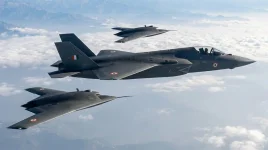
To achieve this, the Ghatak employs a flying-wing configuration—a design that lacks vertical tail fins to significantly reduce its radar signature.
Further enhancing its stealth are serpentine air intakes, which shield the engine's compressor blades from radar waves, and an internal weapons bay that allows the craft to carry precision-guided munitions without the radar-reflecting drag of external pylons.
Technical Specifications and Propulsion
The platform will be powered by a "dry" (non-afterburning) variant of the indigenous Kaveri engine, capable of generating approximately 49 kilonewtons of thrust.This propulsion choice emphasizes fuel efficiency and long-endurance over supersonic speed, allowing the UCAV to remain airborne for extended periods.
| Feature | Ghatak UCAV (Projected) | HAL Tejas Mk1A (Comparison) |
|---|---|---|
| Combat Radius | Over 1,000 km | 300 – 500 km |
| Loiter Time | 5 to 8 hours | Limited by fuel/pilot fatigue |
| Payload | ~1.5 tons (Internal) | ~3.5 to 5 tons (External) |
| Primary Role | Stealth Strike / SEAD | Multi-role Fighter |
Autonomous Intelligence and Deep Strike
Unlike current platforms like the Tejas Mk1A, which often require external targeting support, the Ghatak is being developed as a networked sensor-strike node.It will feature an Active Electronically Scanned Array (AESA) radar and sophisticated electro-optical/infrared (EO/IR) sensors. This suite enables the drone to autonomously detect and track targets deep within enemy territory, functioning as both a persistent surveillance eye and a strike platform.
Open-source data suggests that the Ghatak program evolved from the SWIFT (Stealth Wing Flying Testbed), a smaller technology demonstrator that successfully completed flight trials in 2022.
The scaling up to a 13-ton heavyweight platform indicates India's confidence in mastering complex flight control laws required for tailless aircraft.
Strategic Impact on IAF Doctrine
The induction of the Ghatak is timed to address a looming capability gap. As the IAF prepares to retire its aging fleet of SEPECAT Jaguar deep-penetration strike aircraft over the next decade, the Ghatak is positioned to inherit those high-risk missions.By removing the human pilot from the cockpit in the initial hours of a conflict, the IAF can conduct high-stakes missions against modern integrated air defence systems with significantly reduced risk to life.
If successful, this program will elevate India into an elite group of nations—including the U.S., Russia, and China—possessing indigenous stealth UCAV technology, marking a massive leap forward for the country's defence manufacturing sector.