India’s ambitious initiative to develop the Twin Engine Deck Based Fighter (TEDBF) has achieved a major breakthrough.
The Aeronautical Development Agency (ADA) has officially locked in the aircraft's aerodynamic shape, successfully transitioning the project out of the conceptual design phase and into the realm of physical engineering validation.
To confirm the fighter's real-world capabilities, vital wind tunnel testing contracts have been awarded to the National Aerospace Laboratories (NAL) in Bengaluru.
This milestone represents a significant leap forward for India's indigenous defence aerospace sector.
The TEDBF, envisioned as a heavily armed, 26-ton multi-role fighter, is being purpose-built for the Indian Navy.
It will eventually operate from the decks of India's aircraft carriers, INS Vikramaditya and INS Vikrant, serving as the long-term replacement for the current fleet of Russian-origin MiG-29K jets.
Nearing the Prototype Stage
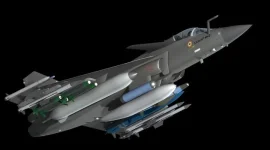
The TEDBF utilizes a highly complex "close-coupled canard-delta" wing layout.Finalizing this external shape means the development team is now executing the last major aerodynamic checks required before physical prototypes can be manufactured.
The primary objective of this current phase is to guarantee the fighter performs safely across all flight conditions and to perfect the complex software required for demanding aircraft carrier operations.
Testing at India's Premier Facilities
CSIR-NAL's National Trisonic Aerodynamic Facilities (NTAF), which houses India's most advanced high-speed wind tunnels, will spearhead these critical evaluations.While the ADA manages the overall design of the aircraft, NAL provides the crucial infrastructure to simulate varied flight environments.
Engineers will test highly precise, 1:6 and 1:7 scale models constructed from durable composites and high-strength steel.
These models will be subjected to simulated airflows ranging from a slow Mach 0.2—replicating a carrier landing approach—all the way up to Mach 1.8 to validate its supersonic combat performance.
Dynamic Assessments for Carrier Operations
Instead of solely measuring basic lift and drag in fixed positions, the TEDBF testing campaign heavily emphasizes "dynamic" wind tunnel trials.This captures how the aircraft handles sudden, unsteady aerodynamic shifts, which is essential for a naval fighter that relies on sharp maneuvers and rapid control inputs.
A major focus of this effort is rotary balance testing. By simulating extreme spins and rolls, engineers can study the aircraft's stability during aggressive flying.
This data is especially crucial for the intense final seconds of a carrier landing, where naval aviators must make rapid, high-angle corrections to safely catch the arresting wires on a pitching deck.
High-Angle Performance and Control
The models are also being pushed to angles of attack (AoA) exceeding 30 degrees to evaluate how the jet handles at dangerously low speeds.The TEDBF’s front canards are specifically designed to generate extra lift and keep the aircraft stable in these exact situations.
This ensures the aircraft can safely recover during "bolters"—scenarios where a pilot misses the landing wires and must instantly apply full throttle to climb away from the ship.
Developing the "Brain" of the Aircraft
The massive volume of data gathered from these wind tunnel tests will feed directly into the TEDBF’s Flight Control Computer (FCC) to establish the fighter's Flight Control Laws (FCL).These algorithms serve as the aircraft's central nervous system, dictating exactly how the engine thrust and flight surfaces react to a pilot's joystick inputs.
Engineers are paying particularly close attention to the airflow interaction between the forward canards and the main delta wings.
Because the air washing off the canards directly impacts the main wings, the movement of all control surfaces must be perfectly synchronized to maximize stability.
Specialized Naval Technologies
The flight control software will feature a dedicated "Power Approach" mode tailored for naval aviation.This automated system manages the jet's thrust and control surfaces to maintain a flawless glide path toward the carrier deck, significantly reducing the pilot's workload during the most dangerous phase of the flight.
The TEDBF is expected to be powered by twin General Electric F414 turbofan engines—the same reliable 98kN thrust engines selected for India's Tejas Mk2 program.
To feed these engines while enhancing the aircraft's stealth profile, the TEDBF utilizes Diverterless Supersonic Inlets (DSI).
The current wind tunnel tests are rigorously scrutinizing these modern intakes.
Engineers are conducting "inlet distortion" tests to guarantee that the GE F414 engines receive a steady, uninterrupted supply of air even during violent maneuvers.
This is vital for carrier safety, as the massive island structure of an aircraft carrier generates highly turbulent, disturbed air—known as a "burble"—directly in the landing path of approaching jets.