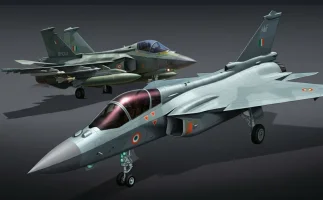
The Aeronautical Development Agency (ADA) has taken a decisive step forward in the development of India's fifth-generation fighter jet.
By officially releasing a comprehensive Statement of Work (SoW), the agency is seeking competent industrial partners to execute the detailed design and engineering of the rear fuselage for the Advanced Medium Combat Aircraft (AMCA).
This development marks a significant transition for the programme, moving it from the initial configuration definition phase into full-scale detailed engineering and industrial execution.
Scope of Engineering Work
According to the tender documents, the selected industry partner will be responsible for the end-to-end design of the rear fuselage structure.This extensive scope includes finalizing the structural layout, defining models, and designing joints and fasteners.
The partner must also conduct rigorous stress and fatigue analyses and perform tolerance stack-up studies.
Ultimately, the goal is to produce manufacturing-ready drawings that will guide the actual construction of the aircraft.
Technical Challenges and Stealth Integration
The rear fuselage is widely considered one of the most complex sections of a modern stealth fighter.It must accommodate the engine bay—expected to house twin GE F414 engines for the AMCA Mk1—and manage high-temperature exhaust zones.
The design must balance these thermal challenges with the strict weight and durability requirements of a combat aircraft.
Furthermore, because the AMCA is a stealth platform, the rear fuselage requires precise structural alignment to maintain low observability.
The design must support radar cross-section (RCS) reduction, ensuring that the aircraft remains difficult to detect by enemy radar.
Phased Execution and Collaboration
The project will follow a milestone-based plan. It commences with the industry partner establishing a design team directly at ADA’s facilities to ensure close coordination.The team will first familiarise themselves with ADA’s digital product lifecycle environment and design standards. Following this, they will proceed to preliminary and detailed stress analysis under various load conditions.
The partner is required to release 3D models and drawings in phases—starting with long-lead items and sub-assemblies—which will all undergo strict validation through ADA’s internal design and airworthiness reviews.
Strategic Implications for Indian Defence
A key aspect of this tender is the protection of national interests.The document explicitly states that all Intellectual Property (IP) generated during this collaboration will belong solely to ADA and the Government of India, preserving the indigenous status of the AMCA programme.
The work will involve strict adherence to security protocols mandated for licensed defence industries.
By distributing such high-complexity design work to domestic partners, ADA is signalling a robust confidence in the Indian private sector's capabilities.
This collaborative model not only accelerates the timeline toward the "design freeze" and tooling definition but also brings the AMCA closer to the prototype manufacturing stage.