- Views: 3K
- Replies: 3
The Defence Research and Development Organisation (DRDO) is preparing for a significant milestone in India’s indigenous military aviation programme.
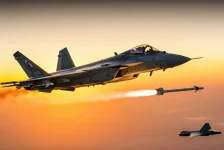
According to recent reports, fresh trials for an enhanced version of the Astra Mk2 Beyond Visual Range Air-to-Air Missile (BVRAAM) are scheduled for early 2026.
This upgraded variant will feature an advanced dual-pulse rocket motor designed to extend the missile's strike range to nearly 200 kilometres.
Boosting Range and Performance
The core of this upgrade lies in the propulsion system. Scientists at the DRDO have successfully optimized the missile’s dual-pulse motor architecture.Unlike standard solid-fuel motors that burn out quickly, a dual-pulse motor can pause and restart its thrust.
The new design focuses on extending the duration of the "second pulse," which provides the missile with sustained energy during the final phase of its flight.
Technical studies confirm that this optimisation will allow the Astra Mk2 to maintain high speeds and manoeuvrability over longer distances.
While the current developmental baseline sits at the 160 km class, the upgraded motor is expected to push the effective engagement envelope to approximately 200 km.
This capability is vital for modern aerial warfare, where "end-game" energy determines whether a missile can successfully hit a fighter jet taking evasive action.
Timeline for Trials and Production
The testing schedule is set to be aggressive yet focused. Flight trials to validate this new motor configuration are planned for the beginning of 2026.These tests will primarily evaluate the missile's burn performance, stability, and guidance accuracy at extreme ranges.
Sources suggest that the development pathway is relatively mature. If the early 2026 trials prove successful, the system may require only a limited number of validation firings.
This rapid validation process could clear the path for series production as early as the middle of 2026, marking a swift transition from development to deployment.
Strategic Advantage for the Indian Air Force
The introduction of a 200-km range air-to-air missile will significantly enhance the combat potential of the Indian Air Force (IAF).A weapon of this class allows pilots to engage and neutralise hostile aircraft from safe "stand-off" distances, well before the enemy can launch their own missiles.
This restores a critical tactical advantage to the IAF, ensuring pilot safety and dominance in contested airspace.
The Astra Mk2 is intended to complement the already inducted Astra Mk1 (which has a range of over 100 km) and will likely be integrated across the IAF’s fighter fleet, including the Su-30 MKI and the indigenous LCA Tejas.
Bulk Orders on the Horizon
Reflecting strong confidence in the indigenous missile ecosystem, the IAF is reportedly preparing to place substantial orders for the system.Reports indicate a potential order for nearly 700 units of the Astra Mk2 once the upgraded variant secures final clearance.
This large-scale procurement serves two purposes: it ensures that multiple fighter squadrons are fully equipped with state-of-the-art weaponry, and it supports the domestic defence industry by providing the economies of scale necessary for cost-effective manufacturing.
By evolving an existing platform rather than starting from scratch, the DRDO aims to deliver a high-performance solution that is both potent and economically viable.