- Views: 3K
- Replies: 3
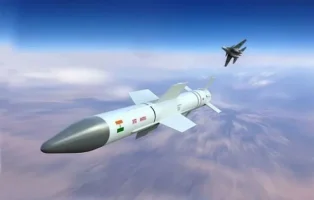
Following the confirmed performance upgrades of the Astra air-to-air missile family, the Defence Research and Development Organisation (DRDO) is reportedly turning its attention to the Rudram-1, India’s primary anti-radiation missile.
Fresh reports indicate that scientists are exploring methods to significantly extend the missile's strike range, potentially pushing it close to the 300 km mark by leveraging the same advanced propulsion technology used in the Astra program.
Building on the Astra Momentum
The initiative comes on the heels of major successes in the Astra project.The Astra Mk1 is already set for a range increase from 110 km to approximately 160 km, while the advanced Astra Mk2 is expected to hit targets between 220 km and 240 km.
Sources close to the development have revealed that DRDO is now applying these learnings to the Rudram-1 (New Generation Anti-Radiation Missile or NGARM).
Currently, the Rudram-1 has a published operational envelope of approximately 200 km.
However, internal assessments suggest that by utilizing the new high-energy propellant formulations validated during the Astra trials, the "enhanced Rudram-1" could achieve a range of nearly 290 km.
Technical Evolution: The Dual-Pulse Advantage
The core of this potential upgrade lies in dual-pulse solid rocket motor technology.Both the Rudram-1 and the Astra Mk2 share this propulsion lineage, though they are engineered for distinct roles.
- The Astra Family: Designed as a slender air-to-air interceptor, the Astra uses its dual-pulse motor to maintain high energy during the "endgame," ensuring it has the speed to chase down agile, maneuvering fighter jets.
- The Rudram-1: Physically much larger, the Rudram-1 measures about 5.5 metres in length—roughly 1.5 metres longer than the Astra. It carries a heavier warhead and a specialized seeker designed to hunt static or mobile radar emitters.
Strategic Impact: Boosting SEAD Capabilities
Extending the Rudram-1’s range to roughly 300 km would be a game-changer for the Indian Air Force's (IAF) SEAD (Suppression of Enemy Air Defence) and DEAD (Destruction of Enemy Air Defence) missions.In modern warfare, anti-radiation missiles are the "eyes and ears" hunters; they home in on the radio frequency (RF) signals emitted by enemy surveillance and fire-control radars. By destroying these radars, the missile blinds the enemy, making the airspace safe for other friendly aircraft to operate.
A 300 km range would allow IAF strike platforms, primarily the Su-30MKI (which serves as the primary launch platform for the Rudram), to fire the weapon from deep within friendly territory.
This "standoff" capability ensures that Indian pilots can neutralize hostile air defence networks without ever entering the lethal range of enemy surface-to-air missile (SAM) batteries.
A Coherent Propulsion Strategy
This development highlights a shift in DRDO’s broader missile strategy.Rather than building entirely new airframes for every incremental gain, engineers are using improved propellant chemistry—specifically high-energy-density fuels—to extract maximum performance from existing designs.
While official flight trials will be required to validate these projections, the scientific direction is evident.
If the Rudram-1 successfully integrates these propellant upgrades, it will cement its position as one of the longest-range anti-radiation missiles in its class globally, significantly bolstering India’s aerial strike potential.