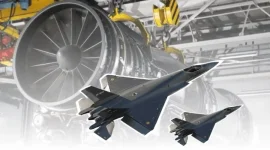
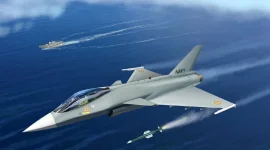
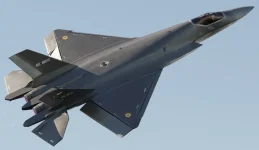
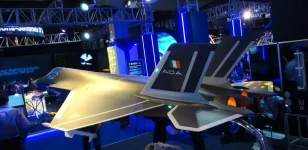
India’s forthcoming fifth-generation stealth fighter, the Advanced Medium Combat Aircraft (AMCA), is set to feature a built-in telescopic boarding ladder, marking a significant departure from the design philosophy of the country's legacy combat jets.
This integrated access system, similar to that found on the American F-35 Lightning II, is not merely a convenience but a strategic design choice intended to enhance operational autonomy, protect sensitive stealth coatings, and ensure rapid sortie generation.
Enhancing Operational Autonomy
The inclusion of an integrated ladder aligns with the AMCA's requirement to operate with minimal ground infrastructure.Unlike fourth-generation fighters such as the Su-30MKI or the Tejas, which rely on external ground ladders for pilot ingress and egress, the AMCA is being designed for deployment from dispersed or austere airbases.
In a conflict scenario, airbases may be degraded, or aircraft may need to operate from highway strips where ground handling equipment is scarce.
A fuselage-integrated ladder allows pilots to board or disembark immediately after landing without waiting for ground crews to position heavy ancillary equipment.
This self-sufficiency is a hallmark of modern fifth-generation doctrines, which prioritise the ability to operate in 'lean' logistical environments.
Protecting Critical Stealth Coatings
For a stealth aircraft, the maintenance of its exterior surface is paramount. The AMCA will be coated with Radar Absorbent Material (RAM) to minimise its radar cross-section.Standard external ladders, which are heavy and cumbersome, pose a constant risk of scratching or chipping these sensitive and expensive coatings during daily operations.
By integrating the ladder directly into the airframe, engineers ensure that the mechanism retracts flush with the fuselage, preserving the aircraft’s clean aerodynamic lines and low-observable geometry.
This reduces the logistical footprint around the jet and eliminates the 'clutter' of ground equipment that can complicate low-observable maintenance regimes.
Furthermore, by removing the need for repeated contact with external metal ladders, the lifespan of the stealth coatings is preserved, potentially lowering long-term lifecycle costs.
Boosting Sortie Generation and Safety
The built-in system also offers tangible benefits during high-tempo combat operations.In situations requiring 'hot refuelling'—where the aircraft is refuelled with engines running—or rapid rearming, the pilot can exit and re-enter the cockpit swiftly.
The elimination of the wait time associated with fetching and securing a ground ladder can save vital minutes, which accumulates to allow more sorties to be flown over the course of a campaign.
From a safety perspective, the integrated ladder offers a standardised and ergonomic solution.
Unlike ad-hoc external ladders which may vary in stability or condition, a built-in ladder provides consistent step geometry and secure handholds tailored specifically to the AMCA’s cockpit height.
This is particularly critical for pilot safety during night operations, in adverse weather, or when wearing bulky flight gear.
A Marker of Design Maturity
The adoption of this feature highlights that the AMCA programme is benchmarking itself against global fifth-generation standards rather than simply upgrading previous indigenous designs.While the Aeronautical Development Agency (ADA) has previously utilised external boarding methods for the Tejas LCA, the shift to internal systems for the AMCA reflects a holistic approach to combat readiness.