The Indian Air Force (IAF) is making significant strides in upgrading its airlift capabilities. Following the Defence Acquisition Council's (DAC) recent Acceptance of Necessity (AoN) in March 2026 to procure 60 aircraft, the Medium Transport Aircraft (MTA) program is entering its decisive final stages.
This major procurement effort aims to phase out the ageing fleet of over 100 Antonov An-32s—which have been the backbone of the IAF's transport fleet since the 1980s—while also reducing the strain on the larger Ilyushin Il-76 heavy lifters.
Three distinct aerospace giants have been vying for the multi-billion dollar contract: Lockheed Martin, Embraer, and Airbus.
However, as the evaluation process deepens, the competition is quickly narrowing down to a two-way battle.
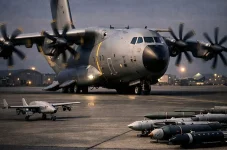
The Airbus A400M Atlas, while highly capable, is increasingly seen as too expensive and excessively large for the IAF's core requirements.
Designed as a crossover between a tactical and strategic airlifter, the A400M boasts a massive 37 to 40-tonne payload.
While this impressive capacity allows it to carry heavy equipment like the army's new Zorawar light tanks in a single flight, its estimated price tag of $200 to $220 million per unit makes it a difficult financial pill to swallow.
For the price of one A400M, India could purchase roughly three medium-class transporters. Using such a premium, high-end asset for the daily 18 to 30-tonne logistics missions originally handled by the 10-tonne An-32s is largely considered an inefficient use of defence budgets.
With Airbus seemingly sidelined by its own size and cost, Embraer's C-390 Millennium has stepped up as a formidable frontrunner.
Powered by twin jet engines rather than traditional turboprops, the C-390 offers a high cruising speed of about 870 km/h.
This speed translates to faster turnaround times and highly efficient long-haul logistics, which is crucial for rapidly moving troops and supplies across India's vast and diverse borders.
Furthermore, its 26-tonne payload capacity hits the absolute sweet spot for the MTA requirements.
Bolstering its pitch, the Brazilian aerospace manufacturer has partnered with Mahindra Defence Systems.
Together, they plan to set up a Final Assembly Line (FAL) within India. This heavily supports the government's "Make in India" and "Aatmanirbhar Bharat" (self-reliant India) visions, promising significant technology transfer, local supply chain integration, and long-term domestic maintenance capabilities.
Standing firmly against the Brazilian jet is the American-made Lockheed Martin C-130J Super Hercules. This aircraft's biggest advantage is its deep, existing integration into the IAF.
India already operates a fleet of 12 Super Hercules aircraft out of Hindon and Arjan Singh airbases, meaning the necessary infrastructure, trained pilots, and maintenance supply chains are already well-established.
Expanding an existing fleet dramatically lowers the risks and lifecycle costs associated with inducting a brand-new aircraft type.
Furthermore, the C-130J is world-renowned for its ability to operate off short, rugged, and unpaved Advanced Landing Grounds (ALGs).
This is a critical necessity for operations in the extreme altitudes of Ladakh (such as the Daulat Beg Oldi landing strip) and the challenging terrains of the Northeast.
Additionally, Lockheed Martin already possesses a strong local manufacturing footprint through its joint venture with Tata Advanced Systems, which currently builds empennages for the global C-130J fleet in Hyderabad.
However, the Super Hercules does have a smaller payload capacity of around 20 tonnes and relies on an older baseline airframe design compared to the modern C-390.
As the Ministry of Defence reviews its options, the decision represents a classic procurement trade-off.
The IAF must choose between the next-generation speed and perfectly matched payload of the Embraer C-390, and the unmatched high-altitude reliability and established domestic ecosystem of the Lockheed C-130J.
Ultimately, the Airbus A400M's premium price and oversized nature have pushed it to the periphery of what is now a high-stakes, two-horse race.