In a significant boost to India’s indigenous fighter programme, US aerospace major GE Aviation is reportedly finalising plans to establish a dedicated Maintenance, Repair, and Overhaul (MRO) facility within the country.
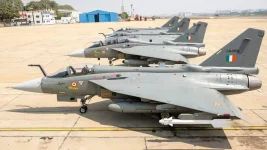
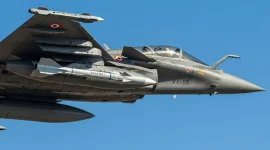
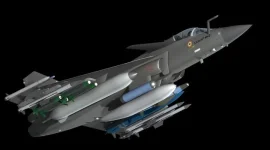
This facility will specifically service the GE F404-IN20 engines that power the Indian Air Force’s (IAF) growing fleet of Tejas Mk1 and Mk1A Light Combat Aircraft (LCA).
The strategic move comes at a critical juncture as the IAF prepares to induct a substantial number of new Tejas fighters, and the earliest operational aircraft in the fleet approach their first major maintenance cycles.
Scaling Support for a Growing Fleet
The decision to set up local sustainment capabilities is driven by the rapid expansion of the F404-powered ecosystem in India.The engines, currently delivered off-the-shelf, have seen a surge in procurement to meet the IAF's modernisation needs.
Beyond the initial batches of more than 75 engines and a 2021 order for 99 units, India has placed fresh orders for 113 additional F404-IN20 engines. These will power the 97 Tejas Mk1A fighters recently approved for acquisition.
With these combined contracts, the total inventory of F404 engines in service and reserve is projected to surpass 270 units. This volume makes a domestic overhaul capability not just a logistical convenience, but an operational and economic necessity.
Recent reports indicate that GE has committed to accelerating deliveries, with 24 engines expected in the 2026–27 fiscal year, scaling up to 30 annually thereafter. As this influx reaches the IAF, the demand for timely maintenance will rise sharply.
‘On-Condition’ Maintenance Philosophy
The F404-IN20 variant introduces a modern maintenance approach that departs from traditional rigid schedules.Unlike older engines that require overhaul after a fixed number of years, the F404 operates on an "on-condition" basis. This concept is designed to maximise aircraft availability by mandating repairs only when specific wear or performance indicators are met.
Field data and accelerated mission testing have validated the engine's robustness, showing it can operate for the equivalent of 1,000 flying hours without requiring major intervention.
On average, the engine necessitates fewer than two shop visits per 1,000 flight hours, a statistic that underscores its reliability in high-tempo operations.
Predictive Health Monitoring
A key enabler of this efficiency is the engine's advanced In-Flight Engine Condition Monitoring System.This technology tracks the health of critical components in real-time, allowing ground crews to detect potential malfunctions before they result in failure.
For the IAF, which operates across a vast spectrum of environments, this predictive capability is a force multiplier.
It allows maintainers to plan interventions proactively, thereby reducing unplanned engine removals and ensuring high sortie generation rates—a critical metric for combat readiness.
Shift to Domestic Sustainment
As the first batch of Tejas Mk1 fighters enters service windows requiring full MRO intervention over the next two to three years, discussions between GE Aviation, the IAF, and Indian industry partners are reportedly gaining momentum.The aim is to appoint an Indian entity—likely Hindustan Aeronautics Limited (HAL) or a private defence firm—to execute complete overhaul services domestically.
Transitioning MRO work to an in-country facility offers multiple strategic advantages. It would significantly reduce the turnaround time for repairs, eliminate the complex logistics of shipping engines abroad, and lower lifecycle costs.
Furthermore, the F404-IN20 is designed with a low Mean Time to Repair (MTTR), a feature essential for sustaining operations in India's diverse geography, ranging from the humid coastal air stations to the high-altitude bases in Ladakh.
If concluded, this agreement would represent a deepening of the aerospace partnership between India and the US.
Beyond immediate support for the Tejas programme, a local MRO ecosystem aligns with the government’s Atmanirbhar Bharat initiative, fostering critical skills and infrastructure within the domestic defence aviation sector.