- Views: 3K
- Replies: 11
Top brass from the Indian Air Force (IAF), alongside leaders from Hindustan Aeronautics Limited (HAL) and domestic aerospace industries, convened at the VM Ghatge Convention Centre in Bengaluru on March 11 for the Bharat Aero 2026 conference.
Coordinated by the Society of Indian Defence Manufacturers (SIDM) and the Centre for Aerospace Power and Strategic Studies (CAPSS), with support from HAL, the gathering focused on transitioning India's military aviation sector from heavy import reliance to complete self-sufficiency.
Under the banner of "Innovating Aerospace, Strengthening Collaboration, Self-Reliance for Next Generation IAF," participants discussed strategies to build a technologically advanced and self-sustaining defence ecosystem.
A central focal point of the summit was a major presentation detailing the "Concept of Next Gen Aircraft Mission."
Displayed prominently during the core panel discussions, this framework maps out the entire combat lifecycle of modern fighter jets operating in highly hostile territories.
It paints a picture of future air warfare that relies heavily on interconnected, multi-domain operations, directly supporting the national 'Atmanirbhar Bharat' (Self-Reliant India) initiative to secure autonomy in aerospace manufacturing.
The Eight-Stage Combat Architecture
The Next-Gen Mission Framework broke down modern aerial warfare into a continuous, eight-step operational cycle designed to ensure aircraft lethality and survivability:- Ingress and Navigation: Approaching enemy airspace using terrain-hugging flight paths and anti-jamming technology, allowing pilots to navigate safely even when standard GPS signals are blocked.
- Aerial Dogfighting: Identifying and engaging enemy aircraft through autonomous targeting systems and cutting-edge sensor fusion, ensuring the optimal weapon is selected for the specific threat.
- Target Striking: Executing highly accurate attacks on designated targets using advanced precision-guided munitions.
- Live Damage Evaluation: Utilising built-in optical and electronic sensors to instantly confirm whether a strike was successful before leaving the area.
- Evading Surface Threats: Using sophisticated electronic countermeasures and self-protection suites to spoof or dodge enemy surface-to-air missiles and ground-based radars.
- Combat Resilience: Keeping the aircraft functioning and lethal despite sustaining physical damage or facing intense electronic warfare and jamming.
- Safe Extraction: Ensuring the pilot and aircraft can successfully exit the combat zone and return to friendly bases for rapid maintenance and turnaround.
- AI-Assisted Flight Management: Deploying artificial intelligence to handle takeoff, poor weather navigation, and air traffic management, thereby reducing the pilot's cognitive load during high-stress missions.
The framework serves as the foundational blueprint for India's upcoming indigenous aviation projects.
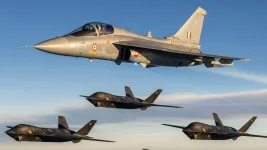
Chief among these is the Advanced Medium Combat Aircraft (AMCA)—an ambitious 5.5-generation stealth fighter currently under development by the Aeronautical Development Agency (ADA) and HAL, which will feature internal weapons bays and advanced radar-evading geometry.
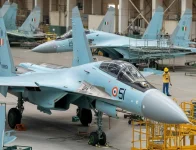
The mission concept also dictates the integration of these high-end survivability features into the upcoming Tejas Mk2 medium-weight fighter, continuous upgrades for the existing Su-30MKI fleet, and the future deployment of uncrewed 'loyal wingman' drone systems.
Ultimately, Bharat Aero 2026 underscored the urgency of establishing a sovereign aerospace manufacturing base to counter evolving regional security threats.
By mapping out every second of a combat mission—from takeoff to safe return—officials made it clear that future supremacy in the skies will require a seamless blend of stealth technology, AI-driven decision-making, and robust domestic supply chains to maintain operational readiness without foreign interference.