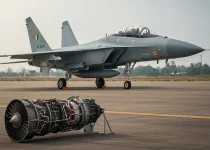
Opinion How 120kN AMCA Engine Partnership with Safran Can Also Anchor India's Indigenous Naval Propulsion Systems for Warships

How 120kN AMCA Engine Partnership with Safran Can Also Anchor India's Indigenous Naval Propulsion Systems for Warships


India’s strategic collaboration with French aerospace giant Safran to develop a high-performance 120kN jet engine is set to provide a dual-domain advantage.

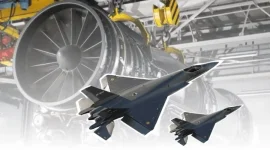
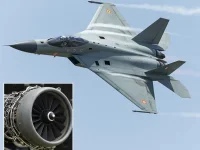
While the primary objective is to power the Advanced Medium Combat Aircraft (AMCA), India’s upcoming fifth-generation stealth fighter, the project is now being viewed as a cornerstone for the nation’s future maritime power.

Experts and officials indicate that the core technology of this aero-engine will be adapted to create indigenous marine gas turbines for the Indian Navy.

From the Skies to the Seas: The Aero-Derivative Advantage​

The transition from aviation to naval use follows a proven global engineering blueprint known as aero-derivative technology.

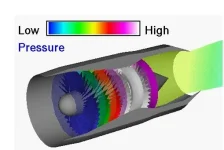
In this process, the "gas generator" or the central core of a jet engine—which produces high-velocity exhaust for flight—is modified to drive a power turbine.

This turbine converts exhaust energy into rotational torque to spin a ship's propellers.

This approach offers several strategic benefits:
  • Compact Power: These units provide high energy output within a small footprint, essential for the cramped engine rooms of warships.
  • Rapid Response: Like fighter jets, these turbines allow vessels to accelerate quickly, a critical requirement for modern naval combat.
  • Weight Efficiency: They are significantly lighter than traditional heavy-duty industrial or diesel engines of similar power classes.

Powering the Next Generation of Warships​

A 120kN class aero-engine core is estimated to produce between 25 and 30 Megawatts (MW) of power when converted for marine use.

This is equivalent to approximately 33,500 to 40,000 shaft horsepower, placing it in direct competition with global standards like the General Electric LM2500 and the Rolls-Royce MT30.

Such power levels are perfectly suited for:
  1. Guided-Missile Destroyers: High-speed platforms requiring massive power for both propulsion and advanced sensor arrays.
  2. Advanced Frigates: Vessels in the 6,000 to 9,000-ton range that need sustained high-speed performance across rough sea conditions.
  3. Future Carriers: Potential integration into the propulsion suites of India's planned indigenous aircraft carriers (IAC-2).

Overcoming the Marine Challenge​

Converting a jet engine for the ocean is not without technical hurdles.

Engineers at India’s Gas Turbine Research Establishment (GTRE), in collaboration with Safran, must implement specific "marinisation" upgrades:
  • Corrosion Resistance: Turbine blades require advanced ceramic and specialized coatings to withstand "hot-salt" corrosion caused by saline environments.
  • Fuel Adaptability: Unlike highly refined jet fuel, marine fuels often contain higher sulfur levels, necessitating more durable combustion liners.
  • Torque Optimization: While aircraft rely on high-speed thrust, ships require heavy low-end torque to move through water, requiring a more robust multi-stage power turbine.

Strategic Impact and "Atmanirbhar Bharat"​

By co-developing this engine with 100% Transfer of Technology (ToT) and shared Intellectual Property (IP), India is breaking a decades-long reliance on foreign propulsion systems.

This move ensures that the Indian Navy will no longer be vulnerable to external supply chain disruptions or sanctions.

Currently, the Indian Navy is also advancing other indigenous "Move" category projects, such as the 6 MW V12 diesel engine by Kirloskar.

However, the Safran-GTRE 120kN partnership represents the "heavyweight" end of this spectrum, promising to give India the sovereign capability to power its most potent frontline surface combatants for the next several decades.
 
If this is indeed true, then it's a remarkable achievement.
Kirloskar is also in progress with its 6MW engine which will be use in combination to 2x to 4x to power the warships...possibly by 2028.
 
Gtre to tell truth?. Safran will benrfit because they going to develop 120kn engine first time with our money. So no risk for safran.
 
I was trained by SNECMA ( now SAFRAN) years back on the M53P2 engine at France and we set up the MRO facility in India. Since last 6 decades, SAFRAN has not progressed much on new engines, with M 88-2/3 BB eing the latest. Their combat engine D&D has been more or less stunted. In this scenario, their joint development of a 120kN engine with India does not look very promising. Such promises have been made in the past to no avail. The problem is further compounded by our own GTRE being given full responsibility. It is going to prove too costly for India. Unless, there is a strong Steering Committee at the RM level closely monitoring with representatives from IAF, Academia Industry having equal powers in the decision making process.
 
Gtre to tell truth?. Safran will benrfit because they going to develop 120kn engine first time with our money. So no risk for safran.
This is exactly what I was trying to express my opinion in this comment section long ago. In my observation looking at how the Indian government with inputs and advice from the government military contractors they never seems to throughly weigh the options on cost and benefits to make the right decision in the right direction. They delibrate on negotiations and then taking donkey years to make a decision which would not be a favourable and not bringing costs and benefits to the Indian defence. I am wondering whether the French Safran has the expertise to successfully produce a 120kN high thrust to weight 5th gen engines for 5th gen fighter aircraft AMCA. As far as my knowledge I know Safran doesn't has the knowledge and expertise to produce a 5th gen fighter aircraft engine. The French seems to be the India's most favoured and preferred military defence supplier. The Indian bureaucrats paying hefty amount of money for the collaboration with Safran. I could see that the huge amount of money is actually to the fund Safran's own 5th gen fighter engine project. Now the important question is the deal signed and work in progres commencing.
 
This is exactly what I was trying to express my opinion in this comment section long ago. In my observation looking at how the Indian government with inputs and advice from the government military contractors they never seems to throughly weigh the options on cost and benefits to make the right decision in the right direction. They delibrate on negotiations and then taking donkey years to make a decision which would not be a favourable and not bringing costs and benefits to the Indian defence. I am wondering whether the French Safran has the expertise to successfully produce a 120kN high thrust to weight 5th gen engines for 5th gen fighter aircraft AMCA. As far as my knowledge I know Safran doesn't has the knowledge and expertise to produce a 5th gen fighter aircraft engine. The French seems to be the India's most favoured and preferred military defence supplier. The Indian bureaucrats paying hefty amount of money for the collaboration with Safran. I could see that the huge amount of money is actually to the fund Safran's own 5th gen fighter engine project. Now the important question is the deal signed and work in progres commencing.
Valid concern. But who else will provide the technology? French engine is better than Russian engine technology. Next 2 options are UK and US. Both will impose restrictions on IP, usage and exports. Only other option left is France.
 
I was trained by SNECMA ( now SAFRAN) years back on the M53P2 engine at France and we set up the MRO facility in India. Since last 6 decades, SAFRAN has not progressed much on new engines, with M 88-2/3 BB eing the latest. Their combat engine D&D has been more or less stunted. In this scenario, their joint development of a 120kN engine with India does not look very promising. Such promises have been made in the past to no avail. The problem is further compounded by our own GTRE being given full responsibility. It is going to prove too costly for India. Unless, there is a strong Steering Committee at the RM level closely monitoring with representatives from IAF, Academia Industry having equal powers in the decision making process.
Valid concern. But who else will provide the technology? 2 options are UK and US. Both will impose restrictions on IP, usage and exports. Only other option left to consider is France. French engine is better than Russian engine technology.
 
Who truly believes that this venture will actually develop a 120KN engine? I'm a non believer. My prediction is after 10 years, engine will still be in development, our engineers will be nowhere close to mastering the core tech, and multiple $B will have gone into Safran's pockets.
 
We have full of stupid at ministry lavel and planing committee when Al 30 is avilable design fighter around it if they did AMCA is operational and have 4-5 squadron too 120 kn need 15 uear to development after then AMCA have no value . chutiye bhare pade hai
 
Since india doesnt know head and tail of Saffran machine its too optimistc and premature to srart chest beating. You never know which part is missed out from agreement and then cry at the time emergency like Source code of Raefel.
 

Forum statistics

Threads
6,496
Messages
63,340
Members
5,023
Latest member
Prabhu
Back
Top