Over the last half-decade, the Pakistan Air Force (PAF) has quietly secured a significant tactical advantage that has largely gone unnoticed in the public domain: a recurring and intimate operational familiarity with the Dassault Rafale.
Through a series of multinational exercises spanning West Asia, Europe, and the Middle East, Pakistani pilots have gained sustained access to the very platform that constitutes the spearhead of the Indian Air Force (IAF).
While these drills strictly forbid the exchange of classified mission data, the strategic value of flying alongside and against a specific aircraft type cannot be overstated.
By repeatedly engaging with the Rafale, observing its energy manoeuvre envelopes, and participating in joint debriefs, the PAF is effectively building a "cognitive database" of its likely adversary’s primary combat asset.
A Timeline of Tactical Exposure
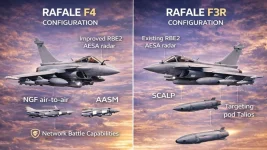
The PAF’s journey of familiarisation began in 2021 during the Anatolian Eagle exercise in Turkey. Here, PAF JF-17 Block II Thunder jets engaged in mock combat scenarios against Rafale fighters from the Qatar Emiri Air Force. This initial encounter marked the start of a systematic effort to understand the French-made fighter’s operational footprint.This trend accelerated in 2023 at the Bright Star exercise hosted by the United Arab Emirates. The drill featured Rafale F3 variants from Egypt and Rafale F3R fighters from Qatar. Operating in the same airspace allowed Pakistani aircrews to witness firsthand how the Rafale integrates into composite air operations, how its pilots utilise onboard sensors like the RBE2 AESA radar, and how the aircraft behaves during high-stress mission execution.
The exposure deepened in 2024 during Exercise Zilzal-II with Qatar. While official communiqués highlighted dissimilar air combat training (DACT) between Pakistani J-10CEs and Qatari Eurofighter Typhoons, reports indicate that Qatari Rafale F3Rs were also part of the operational environment. This reinforced the PAF's familiarity with 4.5-generation European platforms.
By 2025, the Spears of Victory exercise in Saudi Arabia provided an even broader canvas. Pakistani JF-17 Block III fighters—equipped with active electronically scanned array radars comparable to modern Western standards—flew alongside both French and Qatari Rafales. This allowed PAF pilots to compare the doctrinal differences between NATO and Middle Eastern Rafale operators.
Most recently, in January 2026, PAF F-16 Block 52+ fighters deployed to Saudi Arabia for the latest iteration of Spears of Victory. This exercise features participation from French Air Force Rafales and Hellenic Air Force (Greek) Rafales, offering Pakistani pilots yet another opportunity to test their tactics against a Rafale-dominated coalition.
The Asymmetry of Learning
For the PAF, these exercises serve as a rare form of experiential learning. They allow Pakistani strategists to map the Rafale’s decision cycles, engagement geometries, and formation tactics.Understanding how a Rafale manages its energy state or how its Spectra electronic warfare suite reacts to threats provides the PAF with critical insights that simulators cannot replicate.
Conversely, the Indian Air Force faces a stark disadvantage in this domain. While India operates a potent fleet of Rafales, it lacks symmetric exposure to Pakistan’s core aerial assets.
The Chengdu J-10C and the JF-17 Thunder are operated by very few nations outside of China and Pakistan. Consequently, Indian pilots rarely get the chance to fly against these platforms in friendly multinational drills.
Historically, the IAF enjoyed an edge by training against F-16s operated by friendly nations such as Singapore, the United States, and Turkey. This exposure allowed India to develop robust counter-tactics against the F-16, which was long the backbone of the PAF.
However, as the air power equation shifts toward the Rafale and Chinese-origin fighters, the flow of tactical intelligence has reversed.
Strategic Implications for Future Air Defence
In modern aerial warfare, pilot familiarity with an adversary’s machine is often as decisive as the technology itself.Knowing specifically how a target accelerates, at what altitude its sensors are most effective, and how its pilot is trained to react to a missile lock can significantly compress the "OODA loop" (Observe, Orient, Decide, Act) during combat.
As the IAF continues to position the Rafale as the centrepiece of its air defence doctrine, the PAF’s growing repository of tactical knowledge regarding the aircraft becomes a critical variable.
Pakistan’s sustained interaction with the jet across diverse operational cultures is steadily refining its defensive and offensive strategies, creating a challenge that Indian military planners will need to address in their long-term training frameworks.