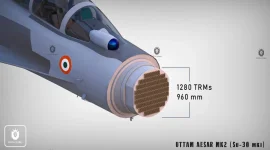
India’s homegrown NETRA Mk1 Airborne Early Warning and Control (AEW&C) fleet is poised for a massive leap in its aerial monitoring capabilities. This enhancement is driven by the integration of a new Gallium Nitride (GaN)-based Active Electronically Scanned Array (AESA) radar.
According to former DRDO Chairman Dr. S. Christopher, who previously led the NETRA programme, one of the three existing NETRA Mk1 jets has already been fitted with this advanced radar and has successfully achieved Final Operational Clearance (FOC).
Open-source records confirm this FOC milestone was officially handed over to the Indian Air Force in late June 2026, cementing the platform's combat-ready status.
While the Defence Research and Development Organisation (DRDO) has kept the exact technical specifications under wraps, the leap from older Gallium Arsenide (GaAs) modules to modern GaN technology is widely understood to be a game-changer.
Defence experts anticipate this transition will bring drastic improvements in how far the radar can see, its ability to pinpoint targets, its heat management, and its overall reliability in the sky.
Taking into account the proven benefits of GaN semiconductors and the historical performance trends of AESA radars, analysts project that this upgrade will vastly expand the NETRA Mk1’s protective umbrella.
The Power of Gallium Nitride
The most immediate edge GaN technology offers is its capacity to produce significantly more radio-frequency power than older GaAs systems.These modern semiconductors are designed to operate at much higher voltages, temperatures, and power densities without suffering the performance drops that plagued older materials.
Consequently, every individual transmitter and receiver module on the radar can emit stronger signals while simultaneously catching weaker return echoes. This translates to better target illumination and the ability to spot incoming threats from much further away.
The baseline NETRA Mk1, which operates a dual S-band AESA radar mounted on a Brazilian Embraer ERJ-145 jet, has historically been able to detect standard fighter aircraft (with a radar cross-section of about 2 square metres) at distances of 250 to 300 kilometres.
With the surge in radiated power and receiver sensitivity provided by GaN, defence sources estimate this detection radius will be pushed beyond the 400 to 450-kilometre mark for similar targets.
Even though exact numbers remain a military secret, an extension of this magnitude represents one of the most drastic upgrades ever integrated into India's indigenous aerial surveillance fleet.
Tracking Stealth and Low-Profile Threats
This upgraded radar will not just see further; it will see with far more clarity. Modern aerial warfare relies heavily on aircraft with reduced radar signatures, low-flying cruise missiles, and compact unmanned aerial vehicles (UAVs). All of these present incredibly faint radar returns that easily evade older systems.Because GaN modules suffer from far less background noise, the radar boasts a much higher signal-to-noise ratio. This allows the system to easily filter out electromagnetic clutter and pick up the faint echoes produced by low-observable or terrain-hugging threats.
For an airborne early warning platform, getting this situational awareness faster and clearer is critical. Its primary job is to provide early threat detection, allowing defenders to act long before hostile forces reach contested airspace.
Solving the Heat Problem
Another major hurdle in airborne radar design is thermal management. Scanning the skies for multiple targets at long ranges generates immense heat, which can throttle a system's capabilities.Unlike older components, GaN devices maintain their efficiency even at extreme operating temperatures. This reduces the heavy reliance on complex cooling systems and allows the radar to sustain high power outputs over long periods without overheating.
This is especially critical for the compact Embraer ERJ-145 platform, which has limited internal space and cooling capacity. Because the GaN radar can safely run hotter, it can maintain peak performance during extended combat air patrols without having to dial back transmitter power to protect its electronics.
Improved thermal efficiency also means the radar can emit longer high-power pulses and operate at increased duty cycles. In the field, this means the crew can sustain demanding long-range search and tracking modes for hours on end without any drop in reliability.
Shaping India's Air Defence Future
Ultimately, seeing an enemy sooner gives military commanders invaluable time.Longer detection ranges allow the Indian Air Force to scramble interceptor jets earlier, reposition ground-based air defence batteries, and orchestrate a coordinated response across India's integrated network.
This newly upgraded NETRA Mk1 fleet will seamlessly complement the upcoming NETRA Mk2 programme, which is currently being developed on larger Airbus A321 airframes.
Working in tandem, these platforms will form the bedrock of India’s future airborne early warning architecture.
Note: Neither DRDO nor the Indian Air Force has officially declassified the performance parameters of the upgraded GaN-based radar. The 400km+ range estimates are analytical projections derived from the known physical advantages of Gallium Nitride technology and should not be treated as officially published figures.