- Views: 2K
- Replies: 3
For decades, the Arjun Main Battle Tank (MBT) has been the subject of intense debate within India’s defence circles.
Often dismissed by critics as a delayed and overweight platform, the reality of the Arjun’s development tells a different story—one of engineering resilience against a backdrop of shifting goalposts and bureaucratic hurdles.
Former DRDO scientist Ravi Gupta has provided a comprehensive account revealing that the Arjun was not delayed by technological failure, but by a procurement system that repeatedly altered requirements while favouring foreign imports.
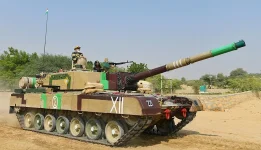
Despite these challenges, the tank has emerged as a formidable machine, arguably superior to the imported platforms that were chosen over it.
The Myth of Technical Delay
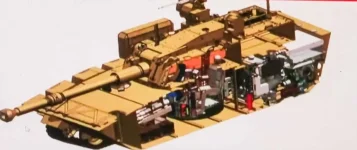
According to Mr Gupta, the popular narrative that the Defence Research and Development Organisation (DRDO) struggled with the technology is factually incorrect. The primary cause for the decades-long timeline was the frequent revision of the General Staff Qualitative Requirements (GSQR).The most damaging of these revisions occurred early in the project. The original requirement was for a tank equipped with a 105mm main gun. However, just as development was stabilizing, the requirement was abruptly changed to a 120mm gun.
“A tank’s gun is not a store item that you bolt on,” Mr Gupta explained. “It is an integral structural and functional part of the platform. Changing from 105mm to 120mm meant higher recoil, greater weight, new stabilization requirements, and a complete redesign of the chassis.”
This single decision effectively forced the engineers to scrap their work and start from scratch. remarkably, the DRDO produced the first prototype of the redesigned Arjun within just one year of this new requirement in 1982.
For context, established global powers typically take up to 15 years to design a new tank from the drawing board.
Moving Goalposts and the Import Lobby
The challenges did not end with the gun. Throughout the 1980s and 1990s, the GSQR was revised repeatedly. New demands for advanced electronics, enhanced protection, and deeper fording capabilities were added piecemeal.Instead of sanctioning new projects—known as "Mark" variants—to accommodate these changes incrementally, the initial project was forced to absorb every new request.
This inevitably led to cost escalations and schedule slippages that were then blamed on the scientists.
Mr Gupta highlights a "policy paralysis" that favoured imports over indigenous patience. In 2000, just as the Arjun was reaching production maturity, the decision was made to import the Russian T-90 tank. At the time, the T-90 was still undergoing evaluation in Russia itself.
The discrepancy in scale is stark. Today, the Indian Army operates over 1,600 imported T-90s, whereas only 124 Arjun Mk-1 tanks were initially inducted. This lack of volume crippled the domestic industrial ecosystem.
“Which industry will invest in production facilities for just 124 tanks?” Mr Gupta asked, noting that no manufacturing ecosystem can stabilize without volume orders.
Had the Arjun been ordered in the thousands, India could have become a major global exporter of armoured vehicles.
Validated by Fire: The Desert Trials
Despite the lack of institutional support, the Arjun was subjected to the most rigorous testing regime in the history of Indian armoured vehicles.While standard global tanks are designed for a lifetime endurance of 5,000 to 7,000 kilometres, Arjun prototypes were run for over 70,000 kilometres during validation.
The tank underwent punishing summer trials in the Rajasthan desert, operating in temperatures exceeding 50°C.
In comparative trials cited by defence analysts, the Arjun frequently outperformed the T-90 in accuracy and consistency, largely due to its superior electronics and stabilization systems which were designed specifically for Indian heat—unlike the imported tanks which initially suffered from overheating electronics.
A Technological Powerhouse
The result of this arduous process is a machine that Mr Gupta describes as a "masterpiece."- Firepower: The Arjun features a 120mm rifled gun—a unique feature in modern tanks that usually use smoothbore guns. This allows it to fire a wide variety of ammunition, including High Explosive Squash Head (HESH) and the indigenous FSAPDS (Fin Stabilized Armour Piercing Discarding Sabot) rounds. It also possesses "Hunter-Killer" capabilities, allowing the commander to search for targets while the gunner engages the current one.
- Protection: The tank is protected by the indigenous "Kanchan" composite armour. Developed at the Defence Metallurgical Research Laboratory (DMRL) in Hyderabad (Kanchanbagh), this armour is widely considered comparable to the famous British Chobham armour. It uses a "sandwich" technique of ceramic and other materials to defeat anti-tank rounds.
- Mobility: One of the Arjun’s standout features is its hydropneumatic suspension. This system provides an exceptionally smooth ride, allowing the crew to fire accurately while moving at speed across rough cross-country terrain—a feat many lighter tanks struggle to match.
The Road Ahead: The Mk-1A
The story of the Arjun has recently turned a new corner with the acceptance of the Arjun Mk-1A, a more advanced version featuring 72 distinct improvements over the original.In 2021, the Ministry of Defence placed an order for 118 of these advanced units, signalling a belated but significant vote of confidence in the platform.
Mr Gupta concludes that the Arjun is more than just a weapon; it represents a sovereign capability. "When I say ‘own metal tank’, I mean full sovereign capability—design, metallurgy, fire control, protection systems, mobility and production," he stated.
Like its legendary namesake from the Mahabharata, the Arjun tank survived a labyrinth of challenges to emerge as a weapon of precision and power.
It stands today not just as a defender of the nation’s borders, but as a testament to the resilience of Indian engineering.