- Views: 2K
- Replies: 2
The Defence Acquisition Council (DAC) has granted the Acceptance of Necessity (AoN) for the Indian Army to procure the Pinaka Long Range Guided Rocket (LRGR), a system also referred to as Pinaka-III.
This approval marks a pivotal shift in India’s artillery capabilities on the western front, enabling the Army to deliver precise, high-volume strikes at ranges previously covered only by expensive missiles.
By extending the reach of the indigenous Pinaka system to 120 km, India is set to operationalise a cost-effective option for deep saturation attacks, fundamentally altering the financial and tactical calculations of cross-border engagements.
Seamless Integration with Existing Assets
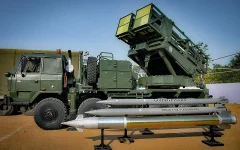
A primary operational benefit of the LRGR-120 is its compatibility with the Indian Army’s current infrastructure.The new 120 km rockets can be launched from the existing fleet of Pinaka launcher vehicles—manufactured by Tata Advanced Systems and L&T—requiring only a modified canister configuration to hold 12 rockets.
This "backward compatibility" is a significant logistical triumph. It negates the need for a new fleet of heavy trucks, speeds up the induction process, and drastically lowers lifecycle costs.
Existing artillery regiments can thus upgrade to deep-strike capabilities without the downtime or expense associated with complete re-equipment.
Bridging the Gap: The Technology of Deep Fire
Building on the success of the Guided Pinaka Mk-II, which has a proven range of 75 km, the new LRGR-120 pushes the engagement envelope to 120 km.This range extension effectively bridges the gap between conventional artillery rockets and expensive tactical ballistic missiles like the Prithvi or BrahMos.
While ballistic missiles are strategic assets used sparingly due to their high cost and limited inventory, the LRGR-120 is designed for mass employment.
Armed with advanced guidance kits—likely utilizing India's NavIC satellite navigation combined with inertial systems—these rockets offer "textbook precision," as demonstrated in the maiden flight test conducted by the DRDO at Chandipur on December 29, 2025.
The Strategic Economics: The Cost-Imposition Dilemma
The most profound impact of the LRGR-120 is economic. The system introduces a favourable "cost-exchange ratio" for the Indian Army.A single guided Pinaka rocket costs a fraction of the sophisticated air defence interceptor missiles an enemy would need to shoot it down.
In a saturation strike scenario—where multiple launchers fire volleys of rockets simultaneously—the defending force faces a financial crisis.
They would be compelled to expend their limited and expensive stock of interceptors to protect their infrastructure.
This creates a classic cost-imposition dilemma: the defender must either exhaust their treasury and missile stocks intercepting cheap rockets or allow the strikes to penetrate their defences.
Industrial-Scale Production Capabilities
The Indian Army’s doctrine of saturation fire is underpinned by a robust domestic manufacturing ecosystem.Key players such as Munitions India Limited (MIL), Solar Industries, and Economic Explosives Limited (EEL) have established large-scale production lines.
Reports indicate that India’s production ecosystem is geared to churn out thousands of rockets, with surge capacities available for wartime requirements.
This industrial depth ensures that the Army can sustain prolonged barrages of the 120 km guided Pinaka without the rationing that typically restricts the use of high-end missiles.
Expanding the Radius of Action
Geographically, the 120 km range brings a vast array of critical targets within striking distance from Indian soil. Strategic calculations suggest that significant portions of Pakistan’s military infrastructure are now vulnerable.Depending on where the launchers are deployed along the border, targets such as logistics hubs, command centres, and railway nodes in areas like Lahore, Gujranwala, Bahawalpur, and Rahim Yar Khan fall within the effective radius.
Furthermore, the system can cover sensitive forward areas including Sialkot and key locations across Pakistan-occupied Jammu and Kashmir (PoJK), allowing the Army to hold these assets at continuous risk.
A Shift in Warfighting Doctrine
The induction of the LRGR-120 supports a doctrinal shift towards "non-contact warfare," allowing the Indian Army to degrade enemy forces deep behind the lines without relying immediately on the Indian Air Force.By presenting a threat that combines volume, precision, and range, the system complicates the enemy’s air and missile defence planning.
The DAC’s approval is thus more than just a hardware upgrade; it is a structural enhancement of India’s deterrent posture.
By combining the economy of artillery with the precision of missiles, the Pinaka LRGR-120 provides India with a sustainable and potent tool to dominate the modern battlefield.