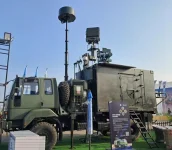
Facing an increasing threat from space-based surveillance, the Indian Air Force (IAF) has initiated a critical indigenous project to shield its S-400 Triumf air defence systems from detection by foreign satellites.
The primary objective of this programme is to mask the significant radar and thermal signatures of the missile batteries, which currently make them vulnerable to identification by synthetic aperture radar (SAR) satellites operated by adversaries.
The Space-Based Threat
Despite the S-400’s formidable reputation as a long-range interceptor, its ground-based components remain exposed to orbital reconnaissance.The system’s key elements—including the massive 91N6E "Big Bird" surveillance radar, the 92N6E "Grave Stone" engagement radar, and the heavy 5P85TE2 transporter-erector-launchers—are mounted on large 8×8 vehicle chassis.
To modern high-resolution SAR satellites, which can "see" through clouds and darkness using radar waves, these metallic structures appear as distinct, bright clusters. This visibility persists even when the units are covered by standard camouflage nets.
Once a battery is imaged, its coordinates can be relayed to adversaries within hours, making the system susceptible to attacks from stand-off weapons or loitering munitions.
While the S-400 is mobile and can relocate quickly, frequent satellite passes (every 60 to 90 minutes) make it difficult to remain hidden for long periods.
Indigenous Stealth Solutions
To counter this, the IAF is collaborating with the Defence Research and Development Organisation’s (DRDO) Electronics & Radar Development Establishment (LRDE) and private sector partners on a two-part material sciences solution.The first phase involves the development of advanced broadband radar-absorbent materials (RAM).
Unlike the coatings used on stealth aircraft, these new materials are specifically engineered to withstand harsh ground environments—ranging from the freezing Himalayas to the scorching desert heat—while effectively absorbing radar waves in the X, Ku, and Ka-bands often used by Chinese and Western military satellites.
The second, more advanced phase focuses on metamaterial-based "frequency-selective surface" (FSS) blankets. These are lightweight, deployable screens that can be set up around a missile battery in minutes.
They are designed to bend incoming radar waves around the equipment, effectively shrinking the battery’s radar cross-section (RCS) without blocking the S-400’s own radar emissions.
This technology is similar in concept to advanced multi-spectral camouflage systems like the Russian 'Nakidka' or the Swedish 'Barracuda', but tailored specifically for the Indian operating environment.
Proven Combat Capability
The urgency of this protection programme stems from the S-400's demonstrated effectiveness.The three operational regiments, inducted since 2021, have reportedly established significant dominance. Reports indicate that during a border skirmish in May 2025, a single S-400 unit successfully denied airspace to the Pakistan Air Force for 72 hours.
This engagement reportedly resulted in the downing of a Pakistani fighter aircraft at a range of over 200 km and an Erieye Airborne Warning and Control System (AWACS) aircraft at 314 km.
Following this display of capability, the S-400 has reportedly become a priority target for Pakistan, with intelligence suggesting that Chinese Yaogan-series satellites have been retasked to track Indian batteries to assist Islamabad.
Future Deployment
By combining these new stealth materials with existing tactics—such as the use of decoy emitters and inflatable dummies—the IAF aims to create "denial zones" of 200 × 200 km where S-400 units can operate silently and virtually undetected."We want the enemy to know we have the S-400, but never know exactly where it is at any given moment," a senior IAF official reportedly stated. "That uncertainty alone will keep their AWACS, fighters, and drones at bay."
The IAF expects the first regiment to be equipped with this indigenous stealth suite by mid-2027, with all five regiments covered by 2030.
If successful, this initiative would make India the first nation to field strategic air defence batteries that are effectively invisible to satellite radar, securing its skies against modern aerial threats.