Following the events of Operation Sindoor in May 2025, the Indian Air Force (IAF) is rapidly accelerating its efforts to establish a robust, close-range shield against enemy unmanned aerial systems (UAS).
The South Western Air Command (SWAC), based in Gandhinagar, has officially released a Request for Information (RFI) inviting domestic defence manufacturers to propose indigenous technologies capable of identifying, monitoring, and destroying hostile drones.
A Strategic Doctrinal Shift
This recent procurement effort highlights a major evolution in military doctrine, prioritising economical yet highly effective counter-drone measures.During Operation Sindoor—a brief but intense conflict sparked by the Pahalgam terror attack—India faced a wave of retaliatory swarm attacks utilizing drones and loitering munitions from Pakistan.
While those threats were successfully neutralized by India's integrated air defence grids, the IAF now seeks to expand its capabilities with dedicated, autonomous platforms designed specifically for the modern, high-volume drone battlefield.
"Launch-and-Forget" Interceptor Drones
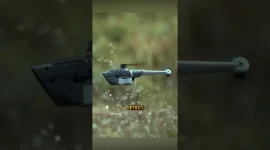
The primary objective of the RFI is the creation of a new generation of compact, "launch-and-forget" interceptor drones.These advanced platforms will be engineered to pursue and eliminate threats independently once deployed. By utilizing built-in sensors, artificial intelligence for targeting, and automated guidance algorithms, these interceptors will operate without the need for constant manual piloting.
This technological leap will drastically minimize operator burden and ensure lightning-fast reaction times against agile, fast-moving swarms.
The Three-Tiered Defensive Shield
To ensure a secure and impenetrable airspace across varying altitudes and distances, the IAF's requirement details a comprehensive, three-stage interception network:- Tier 1 (Close-Range Protection): The foundational layer will feature a man-portable system designed for immediate battlefield use by frontline personnel. This easily transportable unit must detect and intercept low-altitude drones at heights up to 1,000 metres and within a 5-kilometre radius.
- Tier 2 (Mid-Range Mobile Defence): The intermediate layer requires a vehicle-mounted platform capable of firing multiple interceptors in rapid succession (salvo firing). This system will target threats flying at altitudes of at least 5,000 metres and up to 10 kilometres away, specifically aimed at breaking up coordinated swarm formations.
- Tier 3 (Long-Range Command Node): The apex layer involves a highly advanced system that serves a dual purpose: intercepting targets at altitudes of 7,000 metres and distances of 25 kilometres, while simultaneously acting as a centralized command-and-control hub. This node will fuse data from various sensors and seamlessly orchestrate multiple interceptors across the entire engagement zone.
Driving Indigenous Defence Innovation
Initiated by the Regional Aerospace Innovation Division in Gandhinagar (RAID-GN)—which recently also spearheaded the development of the 'Vayu Baan' helicopter-dropped drone—this effort underscores the IAF's commitment to harnessing the expertise of India's domestic aerospace industry.By prioritizing homegrown technologies, the initiative directly supports the national pursuit of self-reliance in the defence sector, ensuring that the resulting military systems are perfectly adapted to India's unique terrain and operational challenges