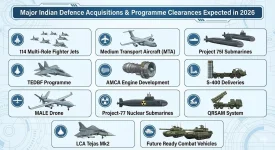
The Indian Air Force (IAF) is expected to receive the fourth squadron of the formidable S-400 Triumf air defence system by late May 2026, marking a significant recovery in delivery schedules.
This development follows high-level confirmations from Russian authorities that supply chain disruptions, previously caused by the prolonged conflict in Ukraine, have been effectively resolved.
Supply Chains Stabilised
The delivery is part of the landmark $5.43 billion (approx. ₹40,000 crore) deal signed between New Delhi and Moscow in October 2018 for five regiments of the S-400 system.While the initial timeline faced delays due to the strain on Russia’s defence industrial base, production capabilities were reportedly ramped up significantly in late 2025.
Moscow has since assured India that the logistics grid is stable and that priority partners will see accelerated fulfillment of outstanding orders.
Boosting the Air Defence Shield
India has already operationally deployed three S-400 squadrons along its western and northern frontiers.These units have created a robust area denial grid against aerial threats from Pakistan and China.
The arrival of the fourth squadron will further tighten this multi-layered air defence shield, specifically plugging gaps in sectors vulnerable to deep-penetration strikes and persistent surveillance.
The S-400 Triumf is globally recognised for its versatility. A typical squadron comprises:
- Battle Management System: The 55K6E command and control centre.
- Surveillance Radar: The massive 91N6E 'Big Bird' radar, capable of tracking up to 300 targets within a 600 km radius.
- Engagement Radar: The 92N6E 'Grave Stone' multi-mode fire control radar.
- Launchers: Mobile Transporter Erector Launchers (TELs) carrying a mix of missiles.
Combat Proven in 'Operation Sindoor'
The urgency for the new squadron follows the system’s reported success during the hostilities with Pakistan in May 2025, referred to as 'Operation Sindoor'. During the conflict, the S-400 demonstrated its lethality by enforcing a strict no-fly zone.Operational data cited by defence sources indicates that Indian batteries successfully neutralised a high-value Pakistani aerial asset at a range of 314 km.
In another engagement, a JF-17 'Thunder' fighter jet was intercepted at approximately 200 km, validating the system’s long-range engagement capabilities using the 40N6E interceptor missiles.
Replenishing the Arsenal
To maintain combat readiness, New Delhi is currently negotiating a standalone contract for approximately 280 fresh interceptor missiles. This procurement aims to replenish the stockpiles expended during the May 2025 operations.Looking ahead, the fifth and final squadron is scheduled for delivery by the end of 2026. Concurrently, Russia and India are finalising plans to establish a domestic Maintenance, Repair, and Overhaul (MRO) facility.
This local hub will be crucial for reducing lifecycle costs and ensuring high availability rates for the S-400 fleet, aligning with India's broader push for self-reliance in defence sustainment.
While the IAF continues to integrate these Russian systems, it is also looking towards the future indigenous 'Project Kusha', a DRDO-led initiative to develop a long-range surface-to-air missile system comparable to the S-400, expected to enter service later this decade.