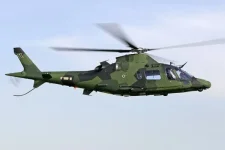
In the high-altitude expanses above Leh, the indigenously developed Light Combat Helicopter (LCH) Prachand has already established a formidable presence along the Line of Actual Control (LAC).
However, military planners are now preparing to enhance this platform with a new class of weaponry. By the end of the decade, the roar of the Prachand’s rotors may be the prelude to a far quieter but deadlier threat for hostile armour.
Sources indicate that the Indian Army Aviation Corps has initiated plans to equip its growing fleet of Prachand helicopters—currently projected at 114 units and rising—with specialized air-launched loitering munitions.
These weapons are being specifically designed to counter modern Main Battle Tanks (MBTs) fielded by adversaries, such as China’s Type 99A and Pakistan’s Al-Khalid-I.
The strategic objective is to bypass traditional frontal armour and the increasingly common "cope cages" (protective slat armour) by striking vertically through the vulnerable turret roof.
Strict Operational Requirements
The Army has outlined precise and rigorous specifications for this new capability.The munitions must be lightweight enough—under 45 kg—to allow each Prachand to carry a minimum of four units (two under each stub wing) without compromising its standard payload of 70mm rockets and Mistral air-to-air missiles.
Technologically, the systems must offer a loiter endurance of 25 to 40 minutes and feature advanced guidance systems, such as fibre-optic links or fully autonomous fire-and-forget modes.
The warhead requirement is equally specific: a tandem configuration combining a shaped-charge precursor with a 4–6 kg high-explosive fragmentation sleeve.
The precursor is designed to penetrate add-on roof armour or protective cages, while the secondary fragmentation charge is intended to incapacitate the crew and internal systems, ensuring the tank is effectively neutralised even if it features blowout panels or protected crew capsules.
Three Distinct Technologies Under Consideration
According to reports, three distinct design concepts are currently being evaluated:- Hybrid Quadcopter: This variant utilises electric ducted fans and fold-out wings for a silent loitering phase, transitioning to a solid-rocket booster for a high-speed terminal dive onto the target.
- Miniaturised Cruise Missile: Based on the proven Nag anti-tank missile technology originally developed for the Rudra helicopter, this option features pop-out wings and a 5 kg tandem warhead.
- Tube-Launched Parafoil: The most unconventional of the three, this system deploys a parafoil for loitering and engages a disposable turbojet engine only in the final five seconds of the attack. This acoustic stealth profile makes it nearly impossible for tank crews to detect the incoming threat until it is too late.
Strategic Context and Indigenous Capability
This development aligns with the Ministry of Defence's broader push for self-reliance in defence manufacturing.Recent open-source reports confirm that the Cabinet Committee on Security has approved the procurement of 156 LCH Prachand helicopters (90 for the Army and 66 for the Air Force), solidifying its role as a critical asset for high-altitude warfare.
The Prachand remains the only attack helicopter in the world capable of landing and taking off at altitudes of 5,000 metres (16,400 feet), making it uniquely upgrading it with loitering munitions would provide Indian forces with a significant tactical advantage in the mountainous terrain of the northern borders.