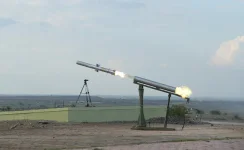
The Indian Army is actively modernising its artillery capabilities by replacing its outdated Russian-designed Grad rocket launchers with the domestically produced Pinaka Multi-Barrel Rocket Launcher (MBRL) system.
Military officials suggest a strategic vision to scale up the Pinaka force to roughly 22 regiments. This transition marks a monumental shift in how India plans to execute rocket artillery warfare in the future.
The expansion is moving rapidly, with reports indicating that the Army aims to operate up to 10 Pinaka regiments by mid-2026, solidifying the system as the backbone of its new Integrated Rocket Force.
This reliance on the Pinaka platform underscores the military's changing combat strategy, which now heavily favours extended reach, pinpoint accuracy, and vehicle survivability over older tactics that relied on overwhelming but unguided firepower.
Consequently, this strategic pivot has stalled earlier initiatives to adopt a new, homegrown 122mm rocket system, originally conceptualised by the Defence Research and Development Organisation (DRDO) as the direct successor to the ageing BM-21 Grad.
The suspended 122mm project was spearheaded by key DRDO facilities, namely the Armament Research and Development Establishment (ARDE) and the High Energy Materials Research Laboratory (HEMRL) in Pune, with manufacturing backing from Nagpur-based Economic Explosives Limited (EEL).
Their collaborative effort successfully birthed a rocket that doubled the strike range of the Soviet-era Grad, pushing it from approximately 20 kilometres to an impressive 40 kilometres.
Even though the 122mm rocket passed its trials with flying colours in 2021, the Army remained reluctant to place bulk orders.
Defence insiders reveal that this hesitation stemmed directly from the unmatched operational capabilities of the Pinaka Mk-1 system. Equipped with heavier 214mm calibre rockets, the Pinaka naturally delivers a vastly superior combination of distance and destructive payload.
While the indigenous 122mm alternative provided a cost-effective way to outrange the legacy Grad systems, it fell short in one critical area: precision. At maximum distances, its accuracy did not meet the stringent demands of the modern battlefield.
The Pinaka, conversely, has proven to be highly accurate. The advanced Guided Pinaka variants utilise an Integrated Navigation System backed by GPS/NavIC, giving field commanders reliable accuracy even at extended ranges up to 75 kilometres.
The growing reliance on the Pinaka is deeply tied to the advent of these guided rocket variants.
Weapons like the Guided Pinaka grant the Army the tactical flexibility to execute highly precise strikes while still retaining the traditional capacity to unleash rapid, devastating barrages—capable of firing a full salvo of 12 rockets in just 44 seconds.
This dual capability makes the system exceptionally valuable for contemporary artillery missions.
Recent global clashes, most notably the ongoing war in Ukraine, have profoundly influenced the Army's strategic calculations. These conflicts have clearly illustrated that old-school "area saturation"—firing massive swarms of unguided rockets over a general area—is an obsolete tactic.
Today's battlefields are increasingly dominated by precision-guided munitions that achieve mission success and obliterate key targets with a fraction of the ammunition.
Military planners now recognise that deploying massive quantities of unguided, or "dumb," rockets is highly inefficient against technologically equipped adversaries.
Modern foes utilise sophisticated surveillance drones, counter-battery radars, and heavily fortified bunkers. To overcome these defences, precision-guided rockets are essential, offering the best operational return on investment by ensuring immediate, accurate hits.
According to defence sources, the Indian Army aims to cultivate a strike profile reminiscent of the highly successful American HIMARS.
Such systems blend rapid battlefield mobility with the lethal precision of guided, long-range munitions.
This strategy enables artillery units to swiftly neutralise high-value enemy assets—such as command headquarters, radar installations, and supply depots—without wasting vast amounts of ordnance.
Finally, the decision to step away from the 122mm programme is heavily rooted in logistics. The Army is determined to streamline its ammunition supply chain by reducing the variety of rocket sizes it has to manage.
Currently, the primary calibres are the 122mm for the remaining Grads and the 214mm for the expanding Pinaka fleet. Introducing a brand-new 122mm manufacturing and storage pipeline would only add unnecessary logistical hurdles to an already complex supply network.