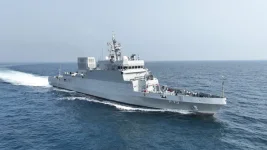
ndia’s first indigenously built aircraft carrier, INS Vikrant, has achieved a major operational milestone by completing 1,000 successful and safe arrested landings, underscoring the Navy’s growing blue-water combat capabilities. Announcing the landmark feat, the Carrier described it as a testament to relentless teamwork, precision training and sustained combat readiness at sea. “From first-light launches to late-night recoveries-1000 traps strong… #INSVikrant achieves 1000 successful and safe arrested landings, marking a testament to relentless teamwork and combat readiness,” the post on X read.
Arrested landings are a critical feature of aircraft carrier operations, enabling high-speed fighter jets to be brought to a swift halt within a limited deck space through a sophisticated arresting mechanism. Unlike land-based airfields, carriers offer only a short stretch of runway, leaving no margin for conventional landings.
Without the arrestor wire system to rapidly decelerate incoming aircraft, jets would overshoot the deck. The mechanism ensures sustained air operations at sea, even amid rough weather and rolling waters. For pilots, the task demands exceptional precision and timing, as they must land on a constantly moving flight deck, a challenge that makes arrested landings among the most exacting skills in naval aviation. Rear Admiral Vivek Dahiya, Flag Officer Commanding Western Fleet (FOCWF), commended Team Vikrant and her embarked squadrons for this proud operational milestone. Designed by the Indian Navy’s Warship Design Bureau and built by Cochin Shipyard Limited (CSL), INS Vikrant, is the largest warship ever constructed in the country.
It was commissioned into the Indian Navy on September 2, 2022. INS Vikrant takes its name from India’s first aircraft carrier, INS Vikrant (R11), which was decommissioned in 1997. With 76 per cent indigenous content, INS Vikrant stands as one of the strongest expressions of India’s push for self-reliance in defence manufacturing. Technically formidable, the 262.5-metre-long and 61.6-metre-wide carrier displaces around 45,000 tonnes and is powered by four gas turbines producing roughly 88 megawatts of power, enabling a top speed of 28 knots.
Designed to accommodate nearly 1,600 personnel, including women officers and sailors, the ship houses about 2,200 compartments. Operating on the Short Take-Off But Arrested Recovery (STOBAR) system, it can deploy up to 30 aircraft, among them MiG-29K fighters, MH-60R Seahawk helicopters and Advanced Light Helicopters. The carrier also produces enough electricity to power nearly 5,000 households, and its internal cabling, if laid out end to end, would stretch from Kochi to Kashi. Vikrant carrier battle group was at the core of Indian Navy’s offensive deterrent posture during Op Sindoor. The Vikrant carrier battle group deployed in the northern Arabian sea, played a key role in strategy of compellence, thereby forcing Pakistan Navy to be in defensive posture and requesting for urgent ceasefire.