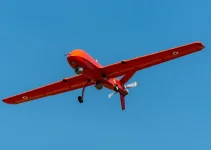
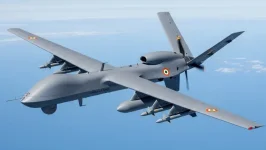
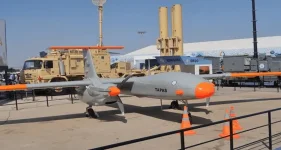
In a major step to strengthen India’s maritime domain awareness, the Ministry of Defence has formally started the procurement of 10 Medium Altitude Long Endurance (MALE) drones for the Indian Coast Guard.
Valued at an estimated ₹2,000 crore, this move reflects the growing reliance on unmanned systems by security agencies to effectively monitor the nation’s vast oceanic and land boundaries.
A Request for Information (RFI) was published on July 15, inviting aerospace and defence manufacturers to present their technical and commercial solutions by the October 7 deadline.
The upcoming fleet will be integrated into the Coast Guard’s Aviation Wing. Its main goal is to deliver non-stop surveillance across crucial maritime areas, especially the sensitive western coast near Pakistan.
The primary role of these advanced aircraft will be conducting Search and Rescue (SAR) operations and ensuring the safety of mariners. They will actively cover India's Exclusive Economic Zone (EEZ), which extends 200 nautical miles from the shore.
Additionally, the drones will patrol the vast Indian Search and Rescue Region, a zone stretching up to 1,000 nautical miles into the sea, which requires systems capable of extremely long flight times.
This purchase represents a significant leap forward for the Coast Guard's technical capabilities. Currently, the service depends on manned Dornier aircraft and helicopters for sea patrols and rescue tasks.
Adding large-scale MALE unmanned systems will allow the force to carry out non-stop reconnaissance missions safely, without subjecting human crews to exhausting and lengthy deployments.
The pressing need to see far beyond the visual horizon is driving this modernisation effort. Equipped with satellite communication (SATCOM), modern MALE drones can stay in the air for over 24 hours at a time.
They instantly send back critical intelligence and reconnaissance data to command centres, allowing constant observation of shipping lanes, fishing zones, offshore infrastructure, and any suspicious activities across vast waters.
Uninterrupted observation is crucial today as India faces rising threats at sea, such as piracy, smuggling, illegal fishing, and unauthorised vessel movements in the Indian Ocean Region.
By introducing these drones, the Coast Guard will be able to keep a constant watch on vital sea routes and border areas, effectively supporting the broader surveillance efforts of the Indian Navy.
This project fits into the government’s wider push to build up the country's unmanned aviation strength.
The Ministry of Defence is concurrently handling a massive ₹32,000 crore initiative to supply 87 MALE drones to the Army, Navy, and Air Force.
Prominent domestic firms, including Tata Advanced Systems, Adani Defence, Hindustan Aeronautics Limited (HAL), Solar Industries, Raphe mPhibr, and Larsen & Toubro, are expected to bid for these tenders, showcasing the rapid growth of India’s home-grown drone industry.
By establishing a distinct procurement track for the Coast Guard, the government highlights the unique demands of coastal security and maritime law enforcement.
While the armed forces focus on military combat, the Coast Guard handles peacetime duties such as pollution control, humanitarian aid, fisheries protection, and rescues. These specialised tasks will greatly benefit from the endurance and capabilities of dedicated unmanned aircraft.
Ultimately, the arrival of these drones will create better teamwork between the Navy, the Coast Guard, and other security bodies by establishing a shared pool of aerial intelligence.
Fitted with modern maritime radars, infrared cameras, and electro-optical sensors, these drones will easily track and identify ships from great distances, even in the harshest weather and sea conditions.