- Views: 2K
- Replies: 4
Fresh images emerging from a recent aerospace exhibition have provided defence analysts with their clearest look yet at the future of India’s air superiority.
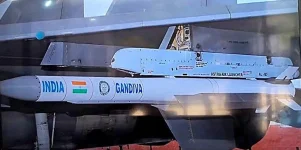
Photographs released by Vayu Aerospace display high-fidelity mockups of the Astra Mk2A, a next-generation air-to-air missile.
These visuals suggest significant design evolutions aimed at extending the weapon's strike range beyond 200 kilometres, directly challenging the capabilities of regional adversaries.
A Larger, More Potent Design
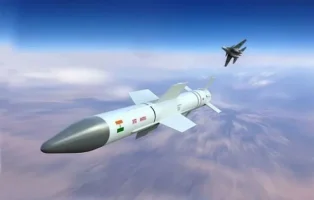
The mockups reveal a missile that has undergone substantial physical growth compared to its predecessor, the inducted Astra Mk-1.The airframe, finished in a gunmetal grey with official Defence Research and Development Organisation (DRDO) markings, features a noticeably elongated body.
Analysis of the photos suggests the missile now measures between 3.8 and 4 metres in length, a roughly 10-15% increase over the 3.6-metre Mk-1.
The changes are not just in length; the missile’s girth has also expanded. The diameter appears to have increased to approximately 178 mm from the previous 160 mm.
This wider fuselage is accompanied by larger tail fins designed to improve stability during high-speed manoeuvres, and a sharper nose cone optimized for speeds exceeding Mach 4.
Engineering the Range Boost
Experts comparing the visual evidence with recent technical disclosures indicate that the Astra Mk2A is engineered to achieve a massive leap in operational range.While the Mk-1 is rated for approximately 110 km, and early Mk-2 prototypes were tested at 160 km, the Mk2A variant is projected to reach distances of 240–250 km.
This performance jump is achieved through a combination of structural and chemical upgrades:
- Increased Propellant Volume: The wider 178 mm diameter significantly increases the internal volume available for fuel. Fluid dynamics principles suggest this 10% increase in width allows for roughly 20% more propellant.
- Dual-Pulse Propulsion: The most critical upgrade is the shift to a dual-pulse solid rocket motor. Unlike standard motors that burn all their fuel at once, this system can pause and reignite. This allows the missile to conserve energy during the cruise phase and save a powerful burst of speed for the final moments of the engagement, making it much harder for enemy aircraft to escape.
- Optimized Trajectory: The missile utilizes advanced navigation systems to fly a "lofted" trajectory. By arcing high into the atmosphere where the air is thinner, drag is reduced, which can extend the range by an additional 30%.
Strategic Implications
The development of the Astra Mk2A is widely seen as India’s direct answer to long-range threats from neighbouring air forces.Specifically, it aims to neutralize the advantage held by the Chinese PL-15 missile, which also utilizes dual-pulse technology and boasts a range exceeding 200 km.
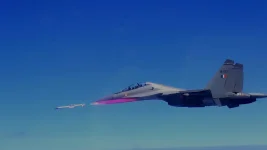
Open-source intelligence confirms that the missile is being integrated with India’s frontline fighters. The display included a port-side variant mounted on a launcher rail suitable for the Su-30MKI and the indigenous Tejas fighter.
Integration with these platforms will allow the Indian Air Force to engage high-value enemy assets—such as refuellers and Early Warning aircraft—from safe standoff distances, fundamentally altering the aerial balance of power in the region.