Putin questions US pressure on India over Russian oil purchases

Putin questions US pressure on India over Russian oil purchases-1.webp


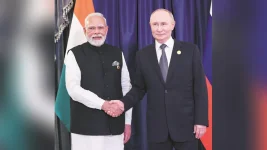
Russian President Vladimir Putin challenged heavy US pressure on India not to buy Russian fuel if the US could do so as he began a two-day state visit, where he was embraced on arrival by Indian Prime Minister Narendra Modi.

Putin spoke in comments to Indian broadcaster India Today, aired hours after landing in New Delhi for a visit during which both countries are seeking to boost mutual trade and expand the variety of items in transactions.

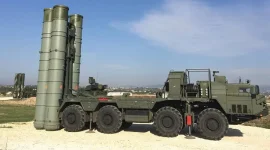
Putin’s first visit to India in four years aims to increase sales of Russian oil, missile systems and fighter jets and widen business links beyond energy and defence equipment, amid US pressure on India to shun Moscow over its invasion of Ukraine.

‘US BUYS NUCLEAR FUEL FROM RUSSIA’​

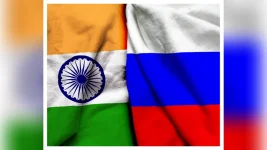
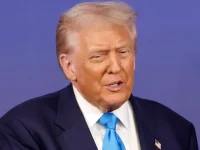
New Delhi and Moscow have strong ties going back to the days of the former Soviet Union, and Russia has been the main source of arms for India for decades. India has also emerged as the top buyer of seaborne Russian oil despite Western sanctions imposed after Moscow launched its invasion of Ukraine in February 2022.India’s crude imports, however, are set to hit a three-year low this month following a punitive US tariff on Indian goods and a tightening of sanctions on Russia, as US President Donald Trump’s administration says India’s purchases of cheap Russian oil help finance Moscow’s war in Ukraine.

“The United States itself still buys nuclear fuel from us for its own nuclear power plants. That is also fuel,” Putin told India Today.

“If the US has the right to buy our fuel, why shouldn’t India have the same privilege? This question deserves thorough examination, and we stand ready to discuss it, including with President Trump,” he said.

India has said Trump’s tariffs are unjustified and unreasonable and pointed at ongoing US trade with Moscow. The US and European Union continue to import billions of dollars worth of Russian energy and commodities, ranging from liquefied natural gas to enriched uranium.

‘RUSSIA-INDIA OIL TRADE RUNNING SMOOTHLY’​

“There is a certain decline in overall trade turnover during the first nine months of this year,” Putin said when asked if Indian oil purchases had fallen under pressure from the West.

“This is just a minor adjustment. Overall, our trade turnover stands almost at the same level as before.”

He added: “Trade in petroleum products and crude oil … Russian oil, is running smoothly in India.”

Asked how India and Russia should deal with Trump and his tariffs, Putin said the US President has advisers who believe that implementing such tariff policies ultimately benefits the US economy. “We hope that, in the end, all violations of World Trade Organization regulations will be rectified,” he said.

MODI GIVES WARM WELCOME TO PUTIN​

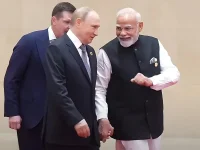
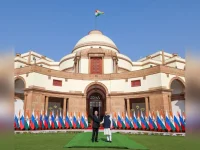
Hours earlier, Modi received Putin at the airport in Delhi, a rare gesture underlining the warm ties between the leaders.

They embraced on a red carpet on the tarmac and then drove away in the same vehicle for a private dinner hosted by Modi.

Senior Russian ministers and a large Russian business delegation were in New Delhi for Putin’s visit and the two leaders will hold summit talks on Friday when they are expected to announce a raft of deals.

“Delighted to welcome my friend, President Putin to India. India-Russia friendship is a time-tested one that has greatly benefited our people,” Modi posted on X ahead of the dinner.

OBJECTIVE TO EXPAND, DIVERSIFY TRADE​

India and Russia aim to raise two-way trade to $100 billion by 2030. Their commerce rose more than five-fold from about $13 billion in 2021 to near $69 billion in 2024-25, almost entirely driven by Indian energy imports.

Bilateral trade eased to $28.25 billion in April-August 2025, reflecting a decline in crude oil imports.

At the same time, India is looking for new destinations to increase exports of its goods hit by the punishing 50 per cent tariff imposed by Trump.

Russia wants to import more Indian goods to balance bilateral trade, which is currently heavily skewed towards energy, Deputy Kremlin Chief of Staff Maxim Oreshkin told a business conference in New Delhi earlier on Thursday.

Indian Trade Minister Piyush Goyal said New Delhi wants to diversify exports to Russia and increase sales of automobiles, electronics goods, data-processing equipment, heavy machinery, industrial components, textiles, and foodstuffs.
 
I would favor to buy at least as much oil from Russia that we may fulfill needs of government firms, key industries, while considering those industries which may 'at least' run during War scenarios 🍵

along with our home oil/gas/energy productions, Iran would also be considered to for CNG gas and oil supply for at least those industries who would need during War scenario ...... the Cold War partners including Iran use Mig29s and other Soviet arms, they will always depends on us for spares parts of those Cold War time arms, as compared to the F16s countries like Sunni states of Gulf who are no reliable 👎

Moscow's influence on Cold War time states are the key to the energy security of "Red Army" side. "the Red Flag" of SU is the need of time 👍
🇮🇳
 
The Red Army, officially the Workers' and Peasants' Red Army, was the military force of the Soviet Union (USSR), formed after the 1917 Russian Revolution to defend the Bolshevik government, playing crucial roles in the Civil War and WWII, and later renamed the Soviet Army in 1946. It was composed of various Soviet Socialist Republics (SSRs) like Russia, Ukraine, Belarus, Central Asian nations, and the Baltics, drawing manpower from across the USSR, but its main bulk became the Russian Ground Forces after 1991. 👍
Formation & Role:
  • Origin: Created by decree in January 1918 by the Bolsheviks, led by Leon Trotsky, to fight the anti-communist White Army.
  • Evolution: Started voluntary, later used conscription, and integrated political commissars to ensure party loyalty.
  • WWII: Became the dominant land force of the Allies, inflicting massive losses on Germany and capturing Berlin. 👍

The "Soviet States" Connection:
  • Manpower: The Red Army recruited soldiers from all constituent republics of the USSR (e.g., Russia, Ukraine, Georgia, Central Asian states), making it a multinational force.
  • Expansion: It expanded into neighboring countries (like Poland, the Baltics, parts of Eastern Europe), establishing Soviet-aligned governments and Soviet Socialist Republics (SSRs).🍵
  • Post-WWII: After the war, its presence solidified Soviet control over Eastern Europe, forming the Eastern Bloc, with Red Army contingents stationed in these new "satellite" states.

Post-Soviet Era:
  • Dissolution: Following the USSR's collapse in 1991, the Red Army (renamed the Soviet Army) was partitioned, with most of its assets forming the foundation of the Russian Armed Forces. 🍵
In essence, the Red Army was the instrument that helped create and defend the Soviet Union and its sphere of influence, drawing soldiers from its member states and establishing Soviet power across vast territories. 👍


.
=>
1765013937229.webp


.
=>

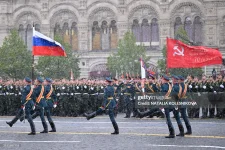
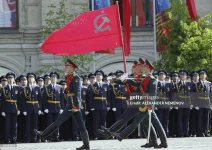
Russian soldiers march across Red Square​

Russian soldiers march across Red Square during a Victory Day Parade in Moscow on May 9, 2008 carrying the flag of victory. The show of strength on the 63rd anniversary of victory against Nazi Germany symbolised Moscow's growing boldness following eight years of rule by Putin, whose hawkish policies have set Russia at loggerheads with Western capitals. AFP PHOTO / ALEXANDER NEMENOV (Photo credit should read ALEXANDER NEMENOV/AFP via Getty Images) 🍵

1765014470134.webp

 
Last edited:
The Red Army, officially the Workers' and Peasants' Red Army, was the military force of the Soviet Union (USSR), formed after the 1917 Russian Revolution to defend the Bolshevik government, playing crucial roles in the Civil War and WWII, and later renamed the Soviet Army in 1946. It was composed of various Soviet Socialist Republics (SSRs) like Russia, Ukraine, Belarus, Central Asian nations, and the Baltics, drawing manpower from across the USSR, but its main bulk became the Russian Ground Forces after 1991. 👍
Formation & Role:
  • Origin: Created by decree in January 1918 by the Bolsheviks, led by Leon Trotsky, to fight the anti-communist White Army.
  • Evolution: Started voluntary, later used conscription, and integrated political commissars to ensure party loyalty.
  • WWII: Became the dominant land force of the Allies, inflicting massive losses on Germany and capturing Berlin. 👍

The "Soviet States" Connection:
  • Manpower: The Red Army recruited soldiers from all constituent republics of the USSR (e.g., Russia, Ukraine, Georgia, Central Asian states), making it a multinational force.
  • Expansion: It expanded into neighboring countries (like Poland, the Baltics, parts of Eastern Europe), establishing Soviet-aligned governments and Soviet Socialist Republics (SSRs).🍵
  • Post-WWII: After the war, its presence solidified Soviet control over Eastern Europe, forming the Eastern Bloc, with Red Army contingents stationed in these new "satellite" states.

Post-Soviet Era:
  • Dissolution: Following the USSR's collapse in 1991, the Red Army (renamed the Soviet Army) was partitioned, with most of its assets forming the foundation of the Russian Armed Forces. 🍵
In essence, the Red Army was the instrument that helped create and defend the Soviet Union and its sphere of influence, drawing soldiers from its member states and establishing Soviet power across vast territories. 👍


.
=>
1765013937229.webp

.
=>

Russian soldiers march across Red Square​

Russian soldiers march across Red Square during a Victory Day Parade in Moscow on May 9, 2008 carrying the flag of victory. The show of strength on the 63rd anniversary of victory against Nazi Germany symbolised Moscow's growing boldness following eight years of rule by Putin, whose hawkish policies have set Russia at loggerheads with Western capitals. AFP PHOTO / ALEXANDER NEMENOV (Photo credit should read ALEXANDER NEMENOV/AFP via Getty Images) 🍵

1765014470134.webp
Some foreign countries like Laos and Angola still put out Hammer and Sickle red flags during celebrations.
 

Forum statistics

Threads
6,201
Messages
61,632
Members
4,524
Latest member
Ankur
Back
Top