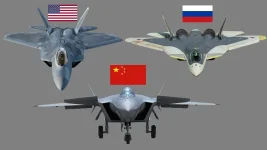
Amidst growing global scrutiny over semiconductor supply chains, Moscow has firmly dismissed reports suggesting that its premier military platforms—including the S-400 air defence system and the Su-57 stealth fighter—are becoming dependent on Chinese-manufactured microchips.
This denial serves as a critical assurance to strategic partners like India, emphasizing that Russian weapons systems remain secure, reliable, and free from external geopolitical leverage.
The Shadow of Sanctions and Speculation
In recent months, defence analysts and strategic experts have debated whether Western sanctions have forced Russia to secretly integrate Chinese microelectronics into its advanced weaponry.The theory posits that restricted access to global markets might have compelled Moscow to source "Monolithic Microwave Integrated Circuits" (MMICs)—the electronic brains behind modern radar and communication systems—from Beijing.
Critics have warned that such a shift could introduce hidden risks, suggesting that relying on Chinese electronics might create a "backdoor" for foreign influence or compromise the performance of systems operated by nations like India.
Concerns Over Security and Reliability
For operators of Russian military hardware, these rumors have triggered serious security concerns.The primary fear is that chips of Chinese origin could theoretically be exploited for cyber espionage, allowing unauthorized access to sensitive operational data.
Furthermore, reliance on a supply chain routed through China raises questions about long-term reliability.
Experts argue that an indirect dependency could lead to inconsistent quality, delivery delays, or even political complications, potentially entangling India’s defence modernisation efforts in the complex web of Sino-Indian relations.
Russia’s Push for Indigenisation
Moving to counter this narrative, Russian officials have outlined an ambitious roadmap for total technological independence.Rejecting the notion of "outsourcing" strategic components, Moscow has confirmed that the sensitive microwave microchips required for its next-generation systems will be fully indigenised.
According to recent open-source intelligence, the timeline for this transition is set for the end of 2027.
Denis Pasler, the Governor of Sverdlovsk Oblast, recently announced the construction of a new facility designed for the serial production of these high-tech components.
This plant is expected to support critical platforms, including the Su-57 fighter’s N036 Byelka radar and the advanced S-500 Prometheus air defence system.
By manufacturing these chips domestically, Russia aims to prove that its most potent weapons are immune to foreign supply shocks.
Strategic Reassurance for India
For India, this commitment to domestic production is of paramount importance.The S-400 Triumf is already a cornerstone of India’s air defence network, and discussions regarding the potential licensed manufacture of the Su-57 involve high stakes regarding technology transfer.
If Russian systems were dependent on Chinese silicon, it would place New Delhi in an untenable position, potentially compromising its strategic autonomy vis-à-vis Beijing.
Russia’s guarantee of a "sovereign silicon" supply chain strengthens the trust between Moscow and New Delhi, ensuring that Indian defence assets remain insulated from the influence of a third party.
The Silicon Frontline
Ultimately, this development highlights a fundamental shift in modern warfare: microelectronics are now as vital as the missiles they guide.Trust between defence partners is no longer solely about shared geopolitical goals but also about the integrity of the code and circuits inside the machinery.
By localising the production of critical chips, Moscow is sending a clear signal that its technology—and by extension, the security of its partners—will not be held hostage by foreign supply chains.