- Views: 58
- Replies: 1
Swedish aerospace major Saab AB has renewed its pitch to the Indian government with an ambitious proposal that extends well beyond the simple sale of fighter jets.
The company has offered to help establish what it terms the world’s most advanced aerospace industrial ecosystem in India.
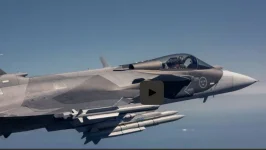
This plan encompasses a comprehensive range of capabilities, including multi-layered design, local manufacturing, long-term maintenance, and technology integration, all centered around the induction of the Saab JAS 39 Gripen E fighter aircraft.
Mikael Franzen, Saab’s Vice President of Aeronautics and Chief Marketing Officer for Gripen, stated that discussions with New Delhi are focused on building sovereign aerospace capacity rather than a traditional buyer–seller arrangement.
The core message of the proposal is to position the Gripen-E not merely as a combat platform, but as a catalyst for a broader industrial transformation within India’s defence sector.
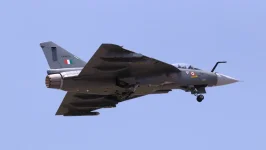
However, this offer comes at a critical juncture, as India’s own fighter development roadmap enters a decisive phase. The development of the Hindustan Aeronautics Limited (HAL) Tejas Mk2, also known as the LCA-AF Mk2, is progressing rapidly.
Designed to bridge the capability gap between lightweight fighters and heavier multi-role jets, the Tejas Mk2 offers a compelling counterweight to the Gripen-E when evaluated through the lenses of operational metrics, growth potential, and long-term strategic autonomy.
Architectural Differences and Payload Capacity
A key point of comparison lies in the fundamental architecture of the two aircraft.The Tejas Mk2 is engineered with a higher Maximum Takeoff Weight (MTOW) of approximately 17.5 tonnes, compared to the Gripen-E’s 16.5 tonnes.
While this numerical difference may seem minor, it signifies a broader design philosophy that prioritises payload flexibility and mission endurance.
The Tejas Mk2 features 11 hardpoints—one more than the Gripen-E—translating into superior carriage options for complex mission profiles.
Furthermore, the Mk2’s projected payload capacity of roughly 6.5 tonnes slightly exceeds the Gripen-E’s 6 tonnes.
Operationally, this margin significantly expands strike flexibility, allowing the Tejas Mk2 to carry a diverse mix of air-to-air missiles, precision-guided munitions, electronic warfare pods, and external fuel tanks simultaneously, without necessitating the same degree of trade-offs required by lighter platforms.
This balance between payload and weight is critical in modern air combat, where multi-role flexibility often dictates the efficiency of a sortie.
A fighter that can deliver heavier standoff weapons while retaining aerodynamic performance provides commanders with a wider range of tactical options.
Radar Capabilities and Indigenous Avionics
The Gripen-E is equipped with the Leonardo Raven ES-05 AESA radar, which is well-regarded for its swashplate-mounted wide field-of-regard.In response, the Tejas Mk2 is being integrated with the indigenous ‘Uttam’ AESA radar, which utilises advanced Gallium Nitride (GaN) technology.
This system is designed to offer comparable performance in terms of situational awareness, tracking capability, and engagement envelopes.
In contemporary warfare, radar superiority is defined not just by raw detection range, but by sensor fusion, electronic resilience, and network integration.
The Tejas Mk2’s architecture is being shaped around these principles, aligning with India’s push for indigenous avionics ecosystems.
By matching the Gripen-E in radar sophistication while retaining domestic control over source codes and future upgrades, India ensures long-term adaptability without the constraints of external dependencies.
Strategic Weapons Integration
One of the most significant advantages of the Tejas Mk2 is its structural growth margin.The aircraft is designed to integrate heavier indigenous standoff weapons, including future long-range precision strike systems such as the BrahMos-NG (Next Generation). This capability fundamentally reshapes the deterrence calculus.
While the Gripen-E remains optimised for a lighter weapons philosophy focused on agility and efficiency, the Mk2’s design anticipates heavier strike roles without compromising survivability.
This distinction highlights divergent operational doctrines. The Gripen emphasises distributed operations and rapid turnaround efficiency, ideal for smaller air forces or specific defensive postures.
In contrast, the Tejas Mk2 leans toward multi-domain strike flexibility, enabling it to function effectively as a bridge platform between lightweight fighters and heavier deep-strike aircraft like the Su-30MKI.
The Choice Between Maturity and Sovereignty
Undeniably, the Gripen-E holds advantages in terms of programme maturity, integrated electronic warfare refinement, and near-term availability.It is a proven, flying system backed by Saab’s decades of operational experience. For air forces requiring immediate capability insertion, this maturity significantly reduces developmental risks and uncertainty.
However, the Tejas Mk2 represents a more strategic value proposition for India: true aerospace sovereignty. Domestic development allows for iterative upgrades, the deepening of local supply chains, and complete cost control over the aircraft’s lifecycle.
A projected lower per-unit cost, combined with an indigenous sustainment infrastructure, could yield substantial long-term economic and operational dividends that imported platforms cannot match.
Ultimately, while Saab’s proposal offers a collaborative model for industrial growth, the Tejas Mk2 ensures that design authority and upgrade pathways remain fundamentally Indian—a factor that is increasingly shaping procurement decisions in an era of global geopolitical flux.