India’s prolonged quest to procure a modern fleet of 3-ton utility helicopters has shifted into a high-stakes competition following the effective suspension of the Ka-226T joint venture with Russia.
In a major move that redefines the procurement landscape, Adani Defence and Aerospace has formed a strategic partnership with the Italian aerospace giant Leonardo (formerly AgustaWestland).
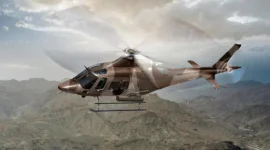
Announced in early February 2026, this collaboration aims to manufacture the AW109 TrekkerM helicopter domestically, presenting it as an immediate and viable solution for the Indian Armed Forces’ urgent aviation needs.
While the AW109 TrekkerM occupies the same light-utility weight category as India’s indigenously developed Light Utility Helicopter (LUH), the two machines represent distinct operational concepts.
The TrekkerM is a twin-engine platform equipped with two Pratt & Whitney Canada PW207C turbine engines. This twin-engine configuration provides vital redundancy and enhanced safety margins, which are considered essential for missions over India’s treacherous Himalayan borders and remote forward bases.
Conversely, the HAL-developed LUH utilises a single engine, prioritising design simplicity and lower lifecycle costs to facilitate mass production and widespread deployment.
The operational gap the military seeks to fill is substantial. The Indian Army and Indian Air Force (IAF) have a combined requirement for approximately 400 helicopters in the 3-ton class to retire their obsolete fleets of Cheetah and Chetak helicopters, some of which have been in service for over five decades.
Defence planners intend to divide this procurement between single-engine and twin-engine models to balance costs with capability.
The single-engine helicopters are intended for routine logistical sorties, whereas the twin-engine fleet is specifically earmarked for high-risk operations, including high-altitude casualty evacuation and reconnaissance, where engine failure could be fatal.
Hindustan Aeronautics Limited (HAL) remains on track to secure the single-engine portion of this requirement, with contracts for around 200 LUH units expected to be formalised.
However, the programme has faced technical hurdles that have slowed its full-scale induction. Notably, the Army has expressed the need for a sophisticated autopilot system—a feature not originally available in the base configuration.
While recent reports indicate that HAL is nearing a resolution on these autopilot certification issues to clear the path for Limited Series Production, these delays have kept the military looking for complementary options.
The uncertainty surrounding the single-engine timeline has blown the twin-engine competition wide open.
Russia is fighting to keep its Ka-226T proposal alive by offering a modified version powered by the indigenous ODK-Klimov VK-650V engine. This new powerplant is intended to replace the originally specified French Safran Arrius 2G1 engines, a change necessitated by international sanctions and supply chain disruptions.
Moscow hopes that indigenising the engine will circumvent geopolitical barriers, allowing the Ka-226T to contest the potential 200-helicopter order against the new Adani-Leonardo entrant.
Adding another dimension to this rivalry is the emergence of the private sector in defence manufacturing.
A partnership between Tata Advanced Systems and Airbus is currently setting up a Final Assembly Line (FAL) in Vemagal, Karnataka. This facility aims to produce the H125 helicopter, with deliveries targeted to begin by 2027.
Although the H125 is primarily a civilian and paramilitary workhorse, the establishment of a local manufacturing ecosystem could make it a contender for military training and light utility roles, offering the armed forces a "Made in India" western alternative.
The implications of this contest extend far beyond the immediate purchase of hardware; they will define the trajectory of India's aerospace industry for the next thirty years.
The Adani-Leonardo bid for the AW109 TrekkerM introduces a proven Western twin-engine platform backed by a new private-sector industrial base.
The Russian Ka-226T relies on deep-rooted legacy defence ties and a promise of engine sovereignty.
HAL’s LUH symbolises the push for total self-reliance, while the Tata-Airbus venture marks the arrival of large-scale private helicopter manufacturing.
Ultimately, for the pilots flying through narrow mountain valleys and the soldiers relying on aerial support, the industrial origins of the helicopter are secondary to performance.
The critical metric is reliability: which machine can consistently take off from high-altitude helipads, withstand harsh weather, and ensure mission safety.
For the government, the decision involves a complex trade-off between operational urgency, financial prudence, geopolitical alignment, and the long-term goal of building a robust domestic defence industry.
With the stagnation of the original Ka-226T deal and the entry of credible new competitors, the race for India’s 3-ton helicopter fleet has evolved from a single-vendor track into a dynamic multi-cornered contest.
Western, Russian, and Indian designs are now poised for a direct face-off. The final selection will not only determine the successor to the ageing Cheetah and Chetak but will also decide which industrial partnership controls the future of military mobility in the region.