- Views: 2K
- Replies: 2
India is preparing for a monumental technological leap in its combat aviation sector.
The upcoming follow-on order of 97 Tejas Mk1A fighter jets will do more than simply expand the Indian Air Force (IAF) fleet; it will completely revolutionise the primary sensory network of the aircraft.
Supplementing the initial order of 73 Mk1A fighters, this new ₹62,370 crore agreement signed in September 2025 will help replace the nation's ageing MiG-21 platforms while fundamentally upgrading the jet's operational hardware.
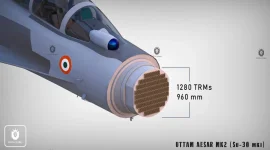
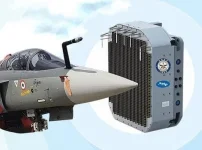
According to reliable reports, this second batch of 97 aircraft will be armed with the domestically designed Uttam Active Electronically Scanned Array (AESA) Fire Control Radar.
Crucially, this new system will be powered by Gallium Nitride (GaN) Transmit/Receive Modules (TRMs).
This integration represents a major generational upgrade from the older Gallium Arsenide (GaAs)-based ELM-2052 AESA radars—imported from Israel—that are currently being installed on the first 73 Mk1A fighters.
The operational advantages of transitioning from GaAs to GaN technology are substantial. GaN components can handle significantly higher power densities—often five to ten times greater than their GaAs counterparts—while simultaneously offering superior thermal efficiency and long-term durability.
For the IAF, this means the new radar will have a vastly extended detection range, potentially capable of identifying fighter-sized targets from over 200 kilometres away. It will also deliver much sharper target resolution and robust resistance against enemy jamming.
When combined with advanced electronic warfare suites and long-range weapons like the Meteor missile, this radar will turn the light combat aircraft into a highly lethal platform in contested skies.
From an engineering perspective, the GaN-based TRMs provide higher output power without sacrificing energy efficiency.
This allows the radar to better discriminate between multiple targets and operate reliably under extreme conditions, cementing its status as a top-tier modern sensor rather than just a local substitute.
The Uttam radar bound for the second batch of jets is expected to house over 900 TRMs, which is a remarkably high module count for a light fighter.
This density of radiating elements guarantees a massive leap in scanning power and beam agility, positioning the domestically built system to directly rival or even exceed the performance of global equivalents.
Hindustan Aeronautics Limited (HAL) Chairman D.K. Sunil has confirmed that the entirely indigenous GaN-based Uttam radar will be standard across the second batch of deliveries, which are slated to begin after 2027.
Developed by the Defence Research and Development Organisation (DRDO), the Uttam system has already proven its mettle through hundreds of flight test hours, successfully demonstrating its capabilities across air-to-air, air-to-ground, and naval operational modes.
For an air force dealing with depleted squadron strength, the successful maturation of this defence technology provides a massive strategic boost.
The massive September 2025 contract breaks down into 68 single-seat fighters and 29 twin-seat trainer jets.
While the first 18 trainer aircraft in the initial production run will retain the older, non-AESA Indo-Israeli MMR radar, there is strong evidence that the remaining twin-seaters in the new batch will upgrade to the Uttam AESA system.
Equipping both combat and training variants with the exact same radar will create vital operational commonality, dramatically simplifying supply chains, aircraft maintenance, and pilot transition training.