As global conflicts in Ukraine and the Middle East evolve into prolonged, industrial-scale wars of attrition, a significant shift is occurring in the global arms trade.
Europe and Israel are increasingly viewing India not merely as a buyer of military hardware, but as a crucial manufacturing base capable of sustaining their war efforts.
This transition is driven by urgent necessities regarding industrial capacity, cost efficiency, and the strategic safety of India’s geographic location.
The New Reality of Industrial Warfare
The ongoing war in Ukraine has fundamentally altered the strategic calculations of advanced militaries.It has demonstrated that precision technology alone cannot win wars; modern conflict consumes vast quantities of basic munitions—artillery shells, missiles, and drones—at rates that European industries cannot match.
For decades, European defence sectors were optimised for peacetime efficiency, resulting in lean supply chains that are now struggling to scale up.
In contrast, reports indicate that European nations, including Italy and the Czech Republic, have begun indirectly sourcing Indian-manufactured 155mm artillery shells to support Ukraine, highlighting India's role in filling this critical gap.
Israel faces a parallel but distinct challenge. Engaged in multi-front operations, it requires a continuous flow of interceptors, loitering munitions, and surveillance drones.
While Israel is a global leader in defence innovation, its domestic manufacturing capacity is limited by size and vulnerable to regional instability.
India as a Strategic Production Hub
In this landscape, India has emerged as a unique partner offering the industrial depth and workforce scale necessary for mass production.Unlike smaller nations, India’s economy and infrastructure can support large production runs without disruption. Recent developments underscore this trend.
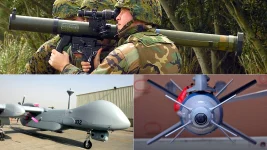
For instance, the Adani-Elbit joint venture in Hyderabad has become a critical node for Israel, manufacturing Hermes 900 drones which are then exported back to Israel for operational use.
Similarly, Sweden’s Saab has established a new facility in Haryana to produce the Carl-Gustaf M4 weapon system, marking the first time a foreign company has been allowed 100% foreign direct investment (FDI) in India’s defence sector.
The Geography of Safety
Geography plays a pivotal role in this strategic pivot. India is physically removed from the active conflict zones in Eastern Europe and the Middle East.This distance provides a layer of security, protecting production lines from immediate threats such as missile strikes or blockades that could cripple factories closer to the front lines.
For partners, outsourcing production to India offers a form of "strategic depth," ensuring that supply chains remain intact even if their domestic facilities are targeted.
For European nations, manufacturing in India also diversifies their supply chains, reducing an over-reliance on the United States or politically sensitive East Asian suppliers.
It allows for the production of subsystems and ammunition at a lower unit cost, helping European firms fulfil their export obligations even when their home factories are overwhelmed.
The Policy Challenge: Reliability Over Permission
However, for India to fully solidify its status as a global defence factory, it faces an internal policy hurdle. Historically, Indian defence exports have been governed by a cautious framework requiring case-by-case government approvals.While suitable for occasional sales, this approach is incompatible with the demands of a global supply chain that requires automatic, predictable movement of goods during wartime.
European and Israeli planners require assurance that approved supplies will not be halted by sudden diplomatic shifts or bureaucratic delays.
Consequently, there is a growing consensus that India must move towards a more streamlined export policy for trusted partners. This would involve pre-approved "corridors" where specific categories of equipment can be produced and shipped without fresh political clearance for every batch.
Conclusion: From Buyer to Supplier
Transitioning to a "No Ask" policy for trusted partners does not imply a loss of sovereignty for India. rather, it aligns India with the practices of major global arms exporters who ensure that industrial commitments are honoured regardless of shifting political headlines.By becoming a reliable manufacturing hub, India stands to gain significant leverage in the global order. This shift moves India beyond its traditional role as a net importer of security, transforming it into a key supplier that underpins the defence capabilities of major powers.
Through partnerships like the manufacturing of Hermes drones and Carl-Gustaf systems, India is already demonstrating that it can set the terms of engagement, accessing advanced technology and sustaining its domestic industry in the process.