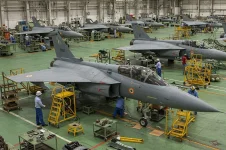
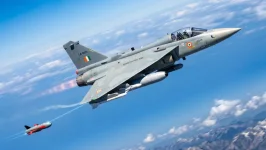
The Tejas Mk1, born out of a profound drive to establish an indigenous fighter programme, has successfully transitioned from a developmental milestone into an active fleet.
As these aircraft accumulate regular flying hours, the primary focus for India's domestic defence aviation sector is shifting toward long-term endurance.
Experts at the Aeronautical Development Agency (ADA) are actively researching methods to safely extend the airframe's lifespan, aiming to keep the fleet combat-ready for decades.
Since 2022, Hindustan Aeronautics Limited (HAL) has been conducting extensive airframe fatigue evaluations at its Ground Test Centre in Bengaluru.
Rather than performing high-speed aerial manoeuvres, these critical static tests simulate thousands of flight hours inside a laboratory.
Engineers systematically apply intense, repeated stress to the jet's structure to perfectly mimic the heavy loads experienced during actual missions.
Strict military airworthiness protocols dictate that an aircraft's structure must prove it can withstand up to four times its intended service life in a controlled testing environment.
Currently, the Tejas Mk1 and the newly inducted Mk1A variants hold a conservative initial certification of 3,000 flight hours.
This standard baseline guarantees absolute structural integrity during the jet's early years.
To push past this limit, designated test aircraft are put through Full Scale Fatigue Testing, which replicates years of high-G turns, weapon deployments, and hard landings.
As long as the airframe shows no signs of cracking or critical wear, the certification limits are systematically raised in data-driven increments—moving from 3,000 to 4,500 hours, and eventually to 6,000 hours.
The Indian Air Force envisions its indigenous fleet matching the 6,000 to 8,000-hour longevity standard set by renowned global fighters, such as the F-16 and Rafale.
Reaching this milestone would allow the Tejas to serve reliably for 30 to 40 years, providing ample time for comprehensive mid-life upgrades.
To facilitate this extension, the ADA is closely examining stress accumulation, load distribution, and material fatigue.
Notably, the Tejas features one of the highest composite-to-surface ratios of any modern fighter.
Carbon-fibre composites make up roughly 45% of the aircraft's weight and cover over 90% of its surface area.
Because these advanced composites react to repeated stress much differently than traditional titanium or aluminium alloys, deep analytical testing is essential to guarantee their long-term durability.
Ultimately, the laboratory findings are continuously cross-referenced with actual flight data gathered from active squadrons.
This vital exchange of information ensures that all future life-extension approvals remain firmly rooted in a blend of rigorous scientific simulation and practical operational reality.