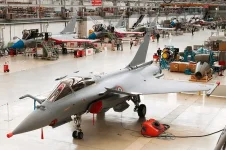
India's monumental initiative to procure 114 Rafale fighter jets through the Medium Role Fighter Aircraft (MRFA) programme has encountered a crucial turning point.
The ability to access the Interface Control Document (ICD) has surfaced as the primary factor that could decide whether this massive agreement moves forward.
High-ranking officials within the Ministry of Defence (MoD) remain optimistic about securing this vital access from France. However, they have made it clear that if Paris denies the ICD, New Delhi is prepared to abandon the negotiations completely.
This strict stance highlights a major transformation in India’s defence acquisition strategy. Operational independence and technological access are no longer seen as optional bonuses; they are strict, non-negotiable requirements.
Under the guidance of Defence Secretary Shri Rajesh Kumar Singh, securing the ICD has become the foundation of India's drive for domestic capability.
Recently cleared by the Defence Acquisition Council (DAC) in February 2026—with the estimated total project value now reaching up to Rs 3.60 lakh crore according to recent government reviews—the MRFA programme extends far beyond merely buying new planes.
It is fundamentally about guaranteeing permanent control over future upgrades and the integration of new armaments.
In recent public addresses, Shri Singh has explicitly outlined that India expects up to 50 percent localisation and the ability to seamlessly integrate its own weapons as absolute prerequisites for the deal.
From a technical standpoint, the ICD acts as a universal digital framework. It serves as a "handshake" protocol that dictates how the fighter jet's central mission computer interacts with external hardware, such as weapon mounting points.
By acquiring this document, Indian scientists and engineers can successfully pair locally manufactured weapons with the Rafale without ever needing the highly guarded, proprietary core source codes owned by the original equipment manufacturer.
This strategy completely avoids one of the most significant hurdles experienced during past acquisitions.
During the previous purchase of 36 Rafale jets, India was entirely reliant on Dassault Aviation to connect any non-French weaponry. This dependency often resulted in steep integration fees and extensive delays, as every single addition required entirely new technical and financial negotiations.
Consequently, it restricted operational adaptability and drove up the long-term costs of maintaining the fleet.
By mandating the inclusion of the ICD directly within the MRFA contract, the Indian government intends to secure permanent integration freedom from day one.
This proactive move will clear the path for the smooth addition of a diverse array of homegrown munitions.
Expected integrations feature the domestic Astra family of beyond-visual-range air-to-air missiles (Mk1, Mk2, and Mk3), the Rudram series of anti-radiation missiles, precision-guided Smart Anti-Airfield Weapons (SAAW), and potentially the next-generation BrahMos-NG supersonic cruise missiles.
The MoD views the acquisition of the ICD as a critical measure of "digital sovereignty." It empowers the nation to steer the technological advancement of its own combat aircraft rather than being trapped in an ecosystem entirely dependent on a foreign vendor.
This vision perfectly matches India's larger strategic goals to minimise dependence on international manufacturers and significantly empower the domestic defence manufacturing sector through the 'Make in India' initiative.
Nevertheless, this requirement remains a delicate subject for France. Handing over ICD-level access raises valid concerns regarding the protection of valuable intellectual property and the overall security of the aircraft's core system architecture.
As discussions between the two nations proceed, finding a middle ground on this interface protocol will be essential, as even a restricted or conditional agreement could become a major hurdle in finalising this historic defence deal.