Defence Minister Rajnath Singh on Saturday asserted that while emerging technologies such as Artificial Intelligence are transforming the nature of warfare, conventional military capabilities remain indispensable, stressing that future conflicts may involve AI but will ultimately be won through national resolve, trained soldiers and credible military strength.
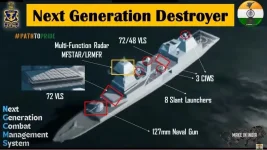
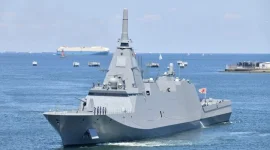
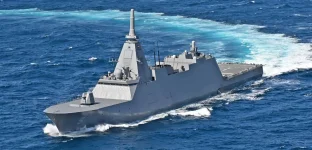
Addressing the gathering during the commissioning ceremony of INS Mahendragiri into the Indian Navy in Andhra Pradesh's Visakhapatnam, Defence Minister Singh said, "While new technologies have certainly transformed the nature of warfare, they have not diminished the importance of conventional warfare capabilities. Strong conventional capabilities remain just as essential today as ever for fulfilling the fundamental principles of warfare. Future wars may be fought with Artificial Intelligence, but they will still be won through national resolve, trained soldiers, and credible military power."
Highlighting the need to balance technological advancement with conventional strength, the Defence Minister said, "New technology and conventional platforms are not adversaries but complements to one another; a conventional platform is incomplete without new technology, and a conventional platform is weakened without it. History bears witness that nations which neglected their conventional strength, lured by the appeal of new technology, had to pay a heavy price."
Emphasising India's long-term defence strategy, Defence Minister Singh said, "Therefore, India's approach is very clear: We must excel in both areas and maintain a balance between them."
"We will invest in future technologies while continuously honing our conventional capabilities. INS Mahendragiri stands as a symbol of this very resolve and commitment," he added.
Referring to India's recent military operations, the Defence Minister said the country's ability to effectively integrate conventional and modern capabilities had already been demonstrated.
"In recent times, we have also witnessed how our conventional and modern capabilities work in tandem when it comes to national security. 'Operation Sindoor' was a prime example of this. During that operation, our armed forces demonstrated that India is fully capable not only of self-defence but also of delivering a decisive response and completely eliminating the enemy when the need arises," he said.
Defence Minister Singh further stated that every warship commissioned into the Navy contributes to strengthening India's broader defence and industrial ecosystem.
"With every ship, India's ecosystem matures, becomes more efficient, and grows more confident."
Explaining the wider economic significance of indigenous warship construction, he said, "That is why I believe that every new ship represents a long-term investment in India's maritime future. The construction of a warship is not merely the building of a vessel; it entails the creation of an entire industrial ecosystem."
"The shipbuilding industry drives progress across sectors such as steel, electronics, sensors, propulsion systems, software, precision engineering, logistics, and numerous ancillary industries. This generates employment opportunities for lakhs of people, fosters the development of new technologies, and imparts fresh momentum to our economy. Thus, when we build a ship, we not only strengthen our Navy but also infuse new energy into India's economic prowess," he added.
The Defence Minister also said India has an ambitious pipeline of naval projects planned for the coming years, with the objective of positioning the country as a global centre for shipbuilding and maritime defence innovation.
"I am confident that, in the near future, our country will carve a distinct niche for itself among the world's leading nations in this sector. We aim to move forward in collaboration with domestic industries, the private sector, MSMEs, startups, innovators, and our global partners. Driven by this vision, our government is working rapidly on the 'Maritime India Vision 2030'," he said.
He further highlighted the government's policy initiatives aimed at strengthening the maritime sector.
"The government has launched several significant initiatives, such as the Maritime Development Fund, the Shipbuilding Financial Assistance Scheme, and the Shipbuilding Development Scheme. These efforts will strengthen our industrial base, expand our shipbuilding capacity, and correspondingly bolster our maritime capabilities to safeguard India's growing economic interests," Singh added.