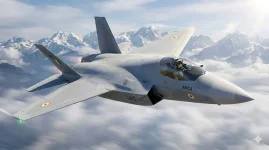
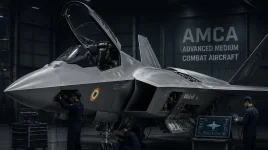
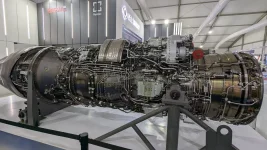
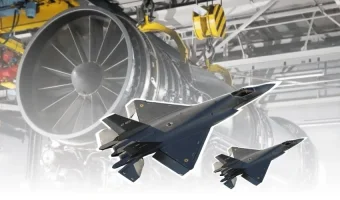
India’s indigenous Advanced Medium Combat Aircraft (AMCA) programme is set to revolutionise the Indian Air Force’s (IAF) maintenance operations with a pioneering software-defined architecture.
In a significant technological leap, the stealth fighter will utilise artificial intelligence (AI) and digital diagnostics to secure a fleet availability rate of 75 per cent, drastically cutting down maintenance delays and boosting combat readiness.
Smart Systems for Higher Readiness
Developed by the Aeronautical Development Agency (ADA), the AMCA will be the first Indian fighter jet to integrate a comprehensive Integrated Vehicle Health Management (IVHM) system.Unlike legacy aircraft that require extensive manual inspections after every sortie, the AMCA will employ a network of sensors to self-monitor its health in real time.
This system is designed to identify potential technical faults before they become critical failures, allowing the aircraft to alert ground crews to necessary repairs even before the pilot lands.
By shifting from a reactive to a predictive maintenance model, the IAF expects to minimize unexpected groundings. This capability is crucial for maintaining a high tempo of operations, ensuring that aircraft can be turned around and relaunched rapidly during conflicts.
AI and Digital Twins
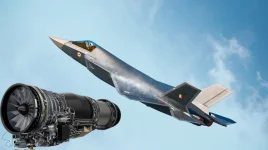
At the heart of this innovation is advanced AI that analyses vast streams of data from the aircraft’s engine, avionics, and airframe.Drawing parallels with global fifth-generation platforms like the F-35, the AMCA’s system will forecast component wear and recommend pre-emptive replacements.
Furthermore, the programme will utilise 'Digital Twin' technology—a virtual replica of the physical aircraft. This allows engineering teams to simulate wear and tear and test repair solutions in a virtual environment before applying them to the actual jet.
To support this, technicians will be trained using augmented reality (AR) and AI-assisted modules, equipping them with the specialised skills needed to maintain complex stealth systems.
Solving Legacy Challenges
This high-tech approach directly addresses historical challenges faced by the IAF, where older fleets often suffer from low availability due to long repair cycles and spare part shortages.Achieving a 75 per cent mission-capable rate—a gold standard for modern air forces—would ensure that a significant majority of the AMCA fleet remains combat-ready at any given moment.
Industry experts note that this predictive capability acts as a force multiplier. By reducing the logistical footprint and life-cycle costs, the IAF can sustain operations longer and more efficiently in contested environments.
Strategic Context and Timeline
The AMCA programme, which received Cabinet Committee on Security (CCS) approval in March 2024 with a budget of ₹15,000 crore, represents India’s push for self-reliance in critical defence technologies.While the text notes an induction window in the 2030s, recent reports suggest the first prototype is expected to roll out around 2028-29, with operational induction targeted for 2034-35.
As the AMCA moves towards its first flight, its emphasis on AI-driven sustainment promises to set a new benchmark for Indian defence aviation, delivering not just a potent fighter jet, but a highly available and resilient air power asset.