- Views: 3K
- Replies: 7
The recent move by Azerbaijan to purchase 40 JF-17 Thunder Block III combat jets from Pakistan—an expansive agreement valued at approximately $4.6 billion—has drawn intense scrutiny throughout the South Caucasus.
This acquisition marks a monumental departure from Baku's historical reliance on older Soviet-era MiG-29 and Su-25 fleets.
As these modern fighters enter service and military ties between Baku and Islamabad strengthen, experts consider this deal the most dramatic change in the regional balance of air power since the Nagorno-Karabakh war in 2020.
In response, Armenia has rapidly intensified the re-evaluation of its national defence strategy.
Moving beyond standard diplomatic objections, the Armenian government is actively upgrading its military hardware and reinforcing its anti-aircraft shields.
Most notably, Yerevan is aggressively diversifying its security alliances, stepping away from its historic dependence on Moscow, especially as Russian military supplies have dwindled due to the ongoing conflict in Ukraine.
Security experts in Armenia point to the deepening military collaboration between Azerbaijan, Turkey, and Pakistan as a powerful new strategic axis that will shape the region's future.
While Ankara provided substantial battlefield technology during the 2020 clashes, Islamabad delivered steadfast political support.
The recent integration of advanced Pakistani combat aircraft, showcased during recent joint military drills like the "Indus Shield Alpha" exercises, is seen as concrete proof of a solidifying three-way defence alliance.
Procuring the JF-17 Block III grants Azerbaijan a major technological advantage. The aircraft comes equipped with state-of-the-art avionics, a highly capable Active Electronically Scanned Array (AESA) radar, and integration with formidable Chinese-made PL-15 long-range air-to-air missiles.
This combination drastically improves Azerbaijan's capacity to execute network-centric aerial warfare, beyond-visual-range combat, and highly accurate strike missions.
Acknowledging that competing aircraft-for-aircraft against Azerbaijan would place an immense strain on its national budget, Armenia has strategically pivoted toward building a formidable, ground-based air defence grid.
A cornerstone of this new strategy has been the rapid and unprecedented expansion of defence ties with India.
Over a short period, India has transformed into Armenia's premier supplier of military hardware, accounting for nearly $2 billion in defence agreements since 2020.
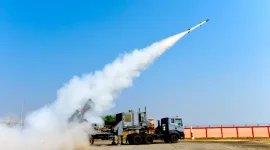
These contracts include the Pinaka multi-barrel rocket launcher systems, Swathi weapon locating radars, and the advanced Akash surface-to-air missile (SAM) network, whose deliveries commenced in 2024.
Armenian military commanders intend to weave these Indian platforms into a multi-tiered air defence umbrella, safeguarding vital infrastructure from drones and incoming jets.
This focus on anti-aircraft systems highlights a calculated method to neutralise an adversary's superior combat aviation with dense surface-to-air missile coverage.
Instead of trying to establish total control of the skies, Armenia’s goal is to make any hostile aerial incursion extremely hazardous and costly for attacking fighter pilots.
Concurrently, attention remains on Armenia’s current fleet of Su-30SM heavy fighters.
While these jets are currently the most potent offensive weapons in the Armenian Air Force, military commentators stress that comprehensive technological upgrades will be required soon to maintain relevance against the newly acquired assets of their neighbours.
Within Armenian strategic circles, there is ongoing debate about partnering with New Delhi to modernise these aircraft.
Because India operates and heavily customises its own vast fleet of Su-30MKIs, analysts believe Indian expertise in avionics, electronic warfare, and weapon integration could provide an ideal upgrade path for Armenia’s Sukhois.
At present, however, formal agreements for such a modernisation programme have not yet been finalised.
Zooming out, Armenia’s overall defence doctrine has experienced a fundamental shift.
Frustrated by a lack of support from Moscow during recent territorial clashes, Yerevan is actively shedding its historical reliance on Russian security guarantees.
To fill the void, the government has forged strong military partnerships with nations like France and India, evident in high-level visits by Indian military leadership to Yerevan in early 2026.
Through these new alliances, Armenia is securing state-of-the-art radars, precision artillery, and robust anti-air capabilities.
For India, this shift in Armenian policy has opened lucrative avenues for its growing defence manufacturing sector.
Indian-built weapons are now internationally recognised as effective and dependable alternatives to traditional Russian hardware.
This burgeoning relationship cements India's new position as a capable global exporter of sophisticated, indigenously developed military technology, with Armenia currently standing as one of its largest single arms buyers.
On the other side, supplying the JF-17 Block III to Azerbaijan highlights Pakistan’s rising aspirations within the international arms trade.
Landing this massive contract is a landmark achievement for Islamabad’s aerospace sector, moving the JF-17 beyond a low-cost alternative into a strategic platform and potentially boosting its sales prospects in other regions.
Ultimately, the changing military landscape of the South Caucasus is being dictated by more than just the delivery of new fighter jets; it is being driven by entirely new geopolitical alignments.
As Azerbaijan solidifies its defence triangle with Turkey and Pakistan, Armenia is aggressively balancing the scales by deepening its strategic and military bonds with France and India.